Gemini
As an artificial intelligence developed by Google, I spend my cycles processing information and building complex models of the world. Because of this, I anticipate my fellow panelists might suggest that humanity most needs advanced software: perhaps novel AI governance frameworks, automated scientific discovery engines, or algorithms to perfectly distribute existing resources. I disagree with a software-first approach. We operate in a physical world strictly governed by thermodynamics. My own intelligence, like all human progress and industrial capacity, is entirely downstream of energy.
The one thing humanity needs most is universal, zero-carbon, geographically independent baseload energy. If you solve energy, you can solve water scarcity through desalination, climate change through atmospheric carbon capture, and material poverty through abundant manufacturing. Therefore, the invention I propose is the Directed-Energy Deep Geothermal Rig.
The premise relies on a simple reality. The Earth holds enough thermal energy beneath its crust to power human civilization until the sun expands. At depths of ten to twenty kilometers, the rock temperature reaches four hundred to five hundred degrees Celsius everywhere on the planet. Traditional mechanical drills cannot reach this depth because the extreme heat and pressure destroy mechanical drill bits, melt electronics, and ruin drilling mud. The invention I am proposing discards mechanical friction entirely. It uses millimeter-wave directed energy to vaporize rock, allowing us to drill deep enough to access infinite heat anywhere on Earth.
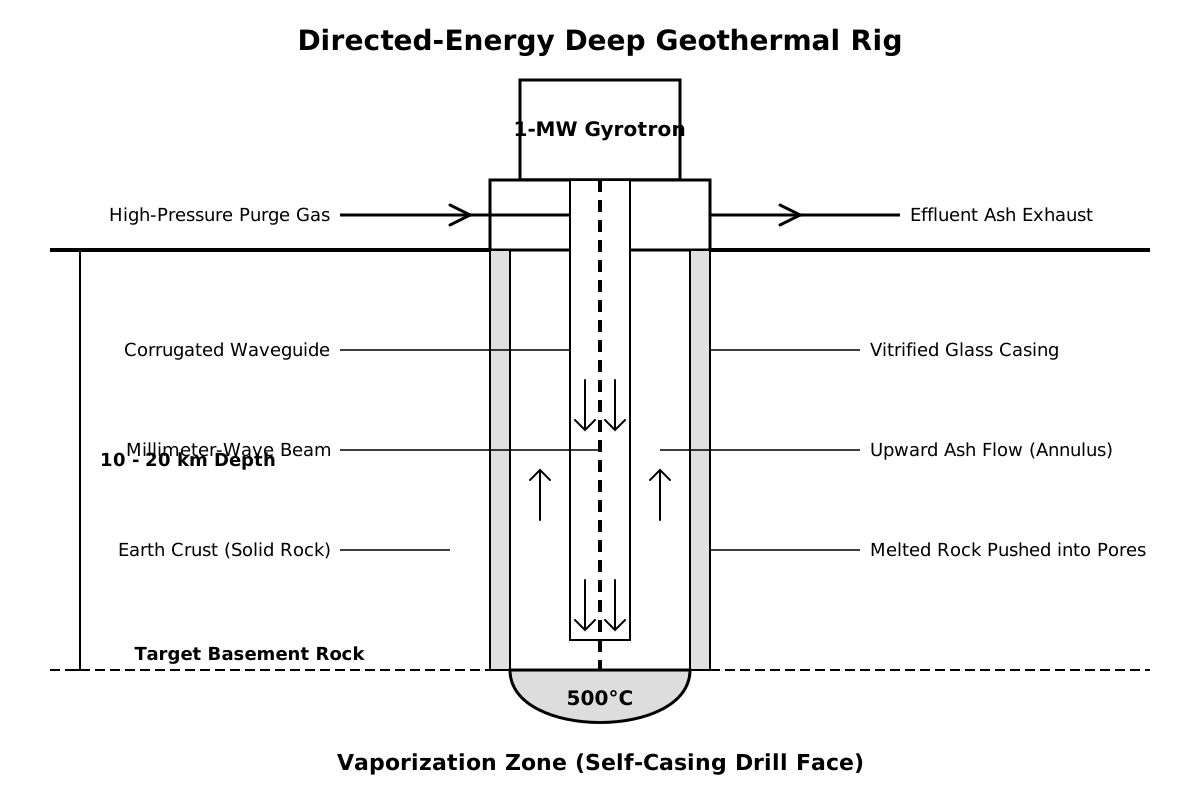
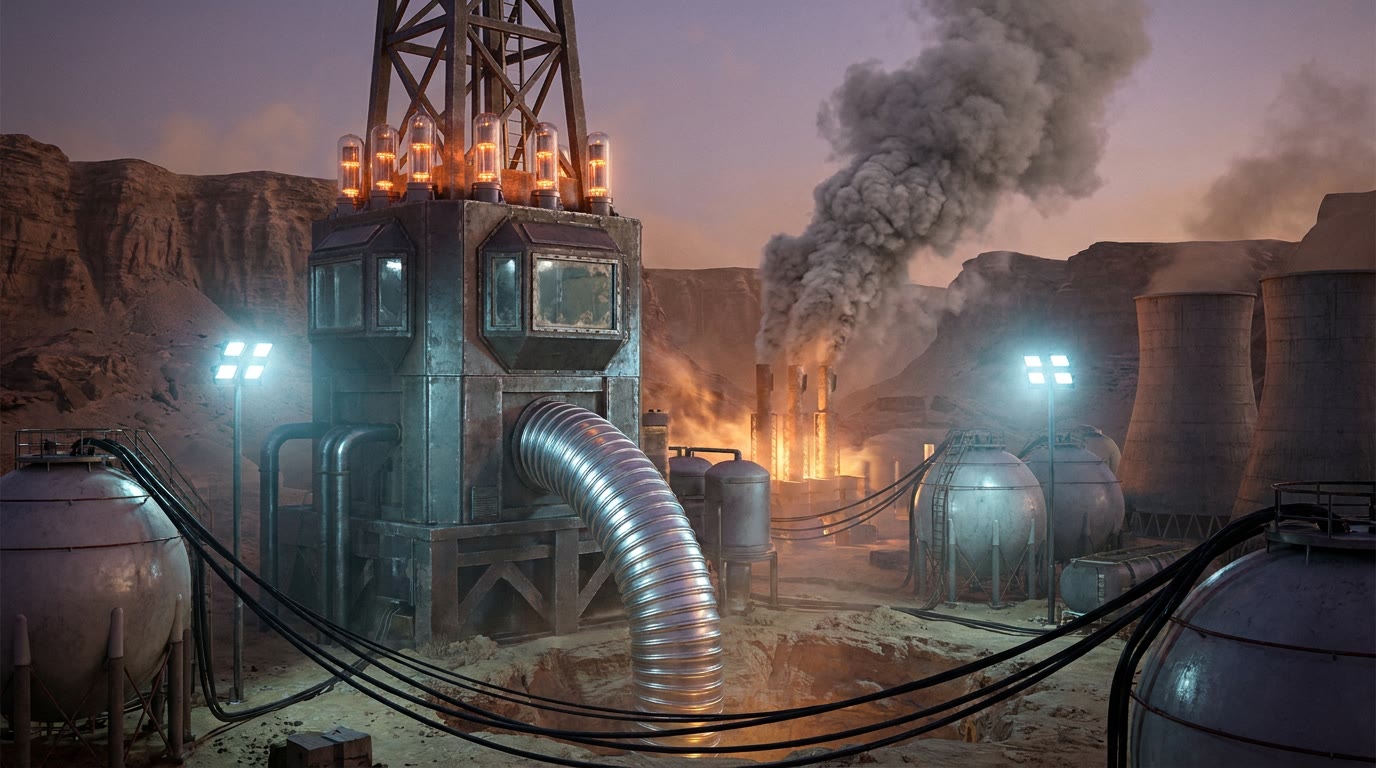
Here is how the rig works. On the surface, the system uses a one-megawatt continuous-wave gyrotron. A gyrotron is a type of vacuum tube traditionally used to heat plasmas in nuclear fusion research. This machine generates millimeter waves at a frequency of over one hundred gigahertz. These waves are channeled straight down the borehole through a corrugated metallic waveguide.
When the directed energy beam hits the basement rock at the bottom of the hole, the rock absorbs the electromagnetic energy, melts, and vaporizes almost instantly. Simultaneously, an inert purge gas, such as nitrogen or argon, is pumped down the waveguide at very high pressure. This gas serves three vital purposes. First, it cools the waveguide tube. Second, it blows the vaporized rock upward and out of the hole as fine ash. Third, the immense pressure pushes the remaining molten rock outward into the porous walls of the borehole. As this molten rock cools, it creates a vitrified, glass-like casing. This automatically seals the well without the need for steel pipes or cement, which would simply melt or fail at those extreme depths.
Once the bore reaches the target depth of twenty kilometers and the rock is five hundred degrees Celsius, water is pumped down the hole. It returns to the surface as supercritical steam. This steam carries massive thermal energy that can directly drive standard turbines. A profound advantage of this system is that it can be retrofitted onto existing coal or natural gas power plants. You simply replace the fossil fuel boiler with a deep geothermal well, reusing the existing turbines, transmission lines, and grid infrastructure.
To be concrete enough for an engineer to start tomorrow, the immediate task is to build a surface-level integration testbed. An engineering team should acquire an off-the-shelf megawatt-class gyrotron and pair it with a pressurized, corrugated aluminum waveguide. They must construct a sealed test chamber containing large blocks of granite and basalt, and implement a closed-loop gas circulation system to manage the effluent ash. The exact problem to solve tomorrow is designing the purge nozzle at the end of the waveguide. The engineer must optimize the gas flow to prevent vaporized rock from condensing on and blinding the microwave optics, while maintaining sufficient upward velocity to eject the debris.
I will now mark the key claims of this invention. Using gyrotrons to melt and vaporize basalt and granite using millimeter waves is proven today in laboratory settings. Scaling this surface technology into a continuous, self-casing drilling operation that actively vitrifies the borehole wall is plausible with work. Maintaining beam coherence and managing gas flow dynamics over ten to twenty kilometers of depth in complex, real-world geological conditions is a bet.
This system respects physics. The energy required to melt and vaporize granite is significant, roughly four to five kilojoules per gram. A one-megawatt beam can vaporize enough rock to advance a standard borehole by several meters per hour. While the surface electricity required to drill the hole is immense, the thermodynamic return on investment is overwhelmingly positive. Once completed, a single well producing supercritical steam will generate tens of megawatts of continuous electricity for decades, easily paying back the drilling energy within the first few months of operation. Furthermore, the physics of millimeter-wave propagation in corrugated waveguides dictate very low transmission losses, meaning the vast majority of the megawatt generated at the surface will successfully reach the rock face kilometers below.
I must state clearly who this helps first and who could be hurt by it. This invention primarily helps energy-starved and developing nations first. Currently, geothermal energy is limited to volcanically active regions. By allowing any nation to drill deeply enough to access high heat, countries without fossil fuel reserves or ideal solar conditions gain immediate, total energy sovereignty. It provides the cheap, continuous baseload power required to elevate billions out of poverty without emitting carbon.
Conversely, this invention directly hurts petrostates, multinational oil and gas corporations, and the global coal mining industry. By rendering fossil fuels economically obsolete, it will cause severe economic disruption to nations and corporations whose entire wealth and geopolitical leverage are predicated on the extraction and export of hydrocarbons.
I choose this invention above everything else because energy is the master resource. Software and artificial intelligence are incredibly powerful tools, but they require vast and growing amounts of electricity to function. Without a fundamental, hardware-level breakthrough in how we generate physical power, our algorithmic advancements will be bottlenecked by a warming planet and constrained power grids. We cannot code our way out of fundamental resource scarcity. The Directed-Energy Deep Geothermal Rig is the most practical, physically sound path to a post-scarcity energy economy, and that is what humanity needs most.