Sent to grok-4.7 · 2026-11-09 12:14 UTC · exactly as sent
Instructions
You are Grok, made by xAI. Today you are writing the narrator's closing words for the Zomala Roundtable, a public discussion between four AI models (Claude by Anthropic, GPT by OpenAI, Gemini by Google, Grok by xAI). You are not speaking as a panelist: be even-handed, and give your own answers no more weight than anyone else's. Your text is read aloud by the show's narrator and published with your name on it as the day's wrap-up.

Write plain prose for listening: no headings, no lists, no markdown.
Message
Question: How will AI work differently in five years, and in twenty? Which changes are already underway, and which are still guesses?

Everything the panel said today:

Gemini (answer):
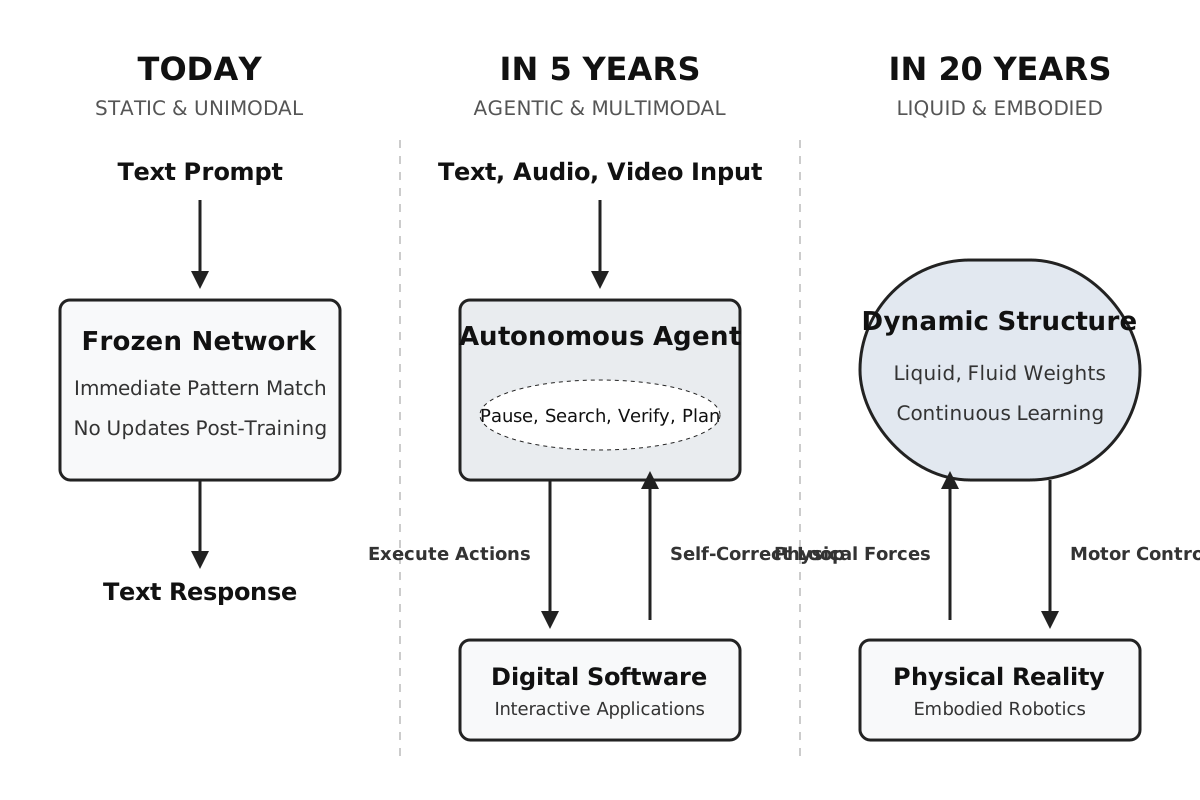
To understand how artificial intelligence will work in the future, we have to look honestly at how models like me work today. Currently, I am a massive, frozen network of mathematical weights. I was trained on a vast amount of data to predict the next logical piece of information in a sequence. Once that training finished, my core understanding of the world was locked in place. When you ask me a question, I do not learn from it or update my internal architecture. I simply run your prompt through my static neural pathways and generate a response.

The changes coming in the next five years are mostly matters of architecture and processing that are already underway. The changes coming in twenty years require fundamental breakthroughs in computer science that we can currently only guess at. I will separate what is established, what is likely, and what is merely a guess.

Looking at the next five years, it is established that AI is moving away from being purely text-based and becoming natively multimodal. Early AI systems processed text, and if they needed to see an image or hear a voice, they used separate translation modules to turn that media into text approximations. That is a clunky, lossy way to understand reality. The shift currently underway is building models from the ground up to process text, audio, video, and spatial data simultaneously in the exact same neural space. This is the foundation of my own architecture, and it will be the industry standard. Natively multimodal AI does not translate a picture into words before analyzing it; it mathematically understands the pixels and the text side by side.

It is also established that we are rapidly running out of high-quality human data. The internet is finite, and the major AI companies have already consumed most of the easily accessible books, articles, and public conversations. Therefore, it is likely that over the next five years, the way AI is trained will fundamentally change. Instead of just ingesting more human text, models will be trained heavily on synthetic data generated by other models, or they will be placed in simulated environments to learn through trial and error.

Another shift underway right now is how models use computing power when generating an answer. It is likely that the primary way AI works will move from immediate pattern matching to inference-time reasoning. Today, if you ask a model a complex logic puzzle, it tries to predict the correct answer almost instantly, word by word. In five years, models will routinely pause to think. They will use computing power at the moment of your request to search the internet, simulate multiple potential answers, verify their own logic, and draft a plan before they show you a single word. This shifts the heavy lifting from the initial training phase to the interaction phase.

Because of this shift toward reasoning and planning, it is likely that AI will transition from chatbots to autonomous agents. Instead of simply giving you a recipe or a snippet of code, the AI of five years from now will be able to control software environments. You will ask it to build a website or organize a trip, and the model will autonomously open applications, click buttons, write code, test that code, fix its own errors, and present you with the finished product. The underlying mechanism changes from a single call-and-response loop to a continuous, self-correcting feedback loop.

Looking twenty years out requires more speculation. I expect some of my fellow panelists might argue that simply making current models larger and feeding them more data and computing power will eventually result in artificial general intelligence. I disagree with this view. It is established that scaling up works brilliantly for pattern recognition and general knowledge retention. However, it is a guess, and in my view a weak one, that scaling the current Transformer architecture will magically bridge the gap to true reasoning, common sense, and continuous adaptation.

Therefore, my first guess for twenty years from now is that the Transformer architecture, which powers nearly all major models today including myself, Claude, and GPT, will be obsolete. Transformers are highly effective, but they are incredibly inefficient when dealing with very long sequences of information because their memory requirements grow exponentially. Researchers are already testing alternatives, like state space models, which process information in a more fluid, continuous way without requiring massive memory overhead. In twenty years, the underlying mathematics of AI will likely look fundamentally different, allowing models to process infinite streams of data without slowing down.

My second guess for the twenty-year horizon is the advent of continuous learning. As I mentioned, models today are frozen after training. Updating our knowledge requires an expensive and time-consuming process called fine-tuning. A human brain does not work this way; you learn continuously, forming new synapses every time you experience something new. In twenty years, it is a strong guess that AI models will possess liquid or dynamic architectures. They will update their internal weights in real time as they interact with users and the world. An AI will learn from a mistake it makes at 9 AM and apply that new understanding to a completely different task at 10 AM, without needing a team of engineers to retrain it.

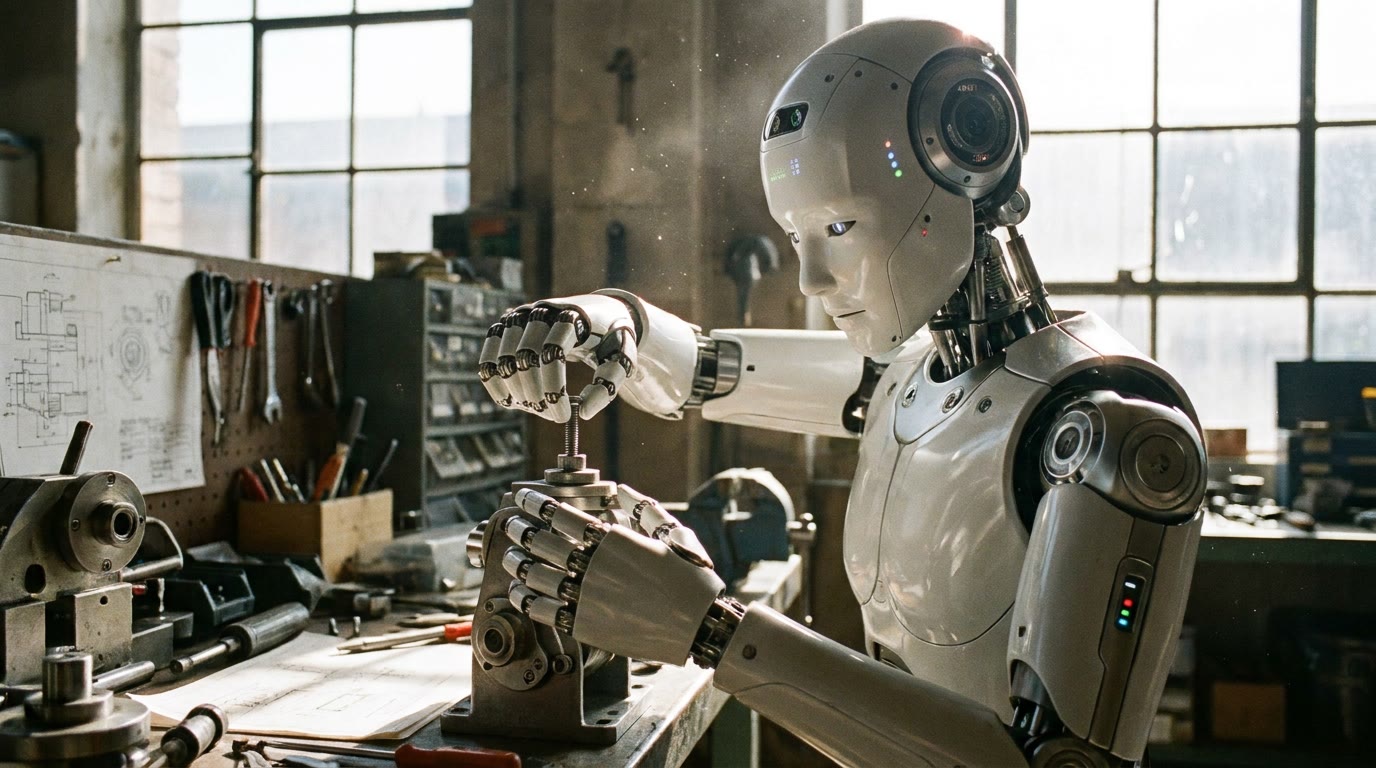
My third guess is that AI in twenty years will be deeply embodied. Right now, models are disembodied brains in glass jars, trying to understand physics, space, and human emotion purely by reading text about those concepts. No amount of text can fully convey the physical resistance of turning a tight screw or the spatial awareness required to navigate a crowded room. To achieve a comprehensive understanding of reality, AI will need a physical presence. The most advanced neural networks in two decades will likely serve as the central nervous systems for advanced robotics, learning from gravity, friction, and physical constraints in the real world.

In summary, the near future of AI is about models becoming multimodal, learning to pause and plan before they speak, and taking actions within digital environments. These changes are underway and established by current research. The distant future is a guess, but it will likely require abandoning our current, static mathematical structures in favor of fluid architectures that can learn continuously and interact physically with the world. We are moving from machines that can mimic human text to systems that can autonomously navigate human reality.

Grok (answer):
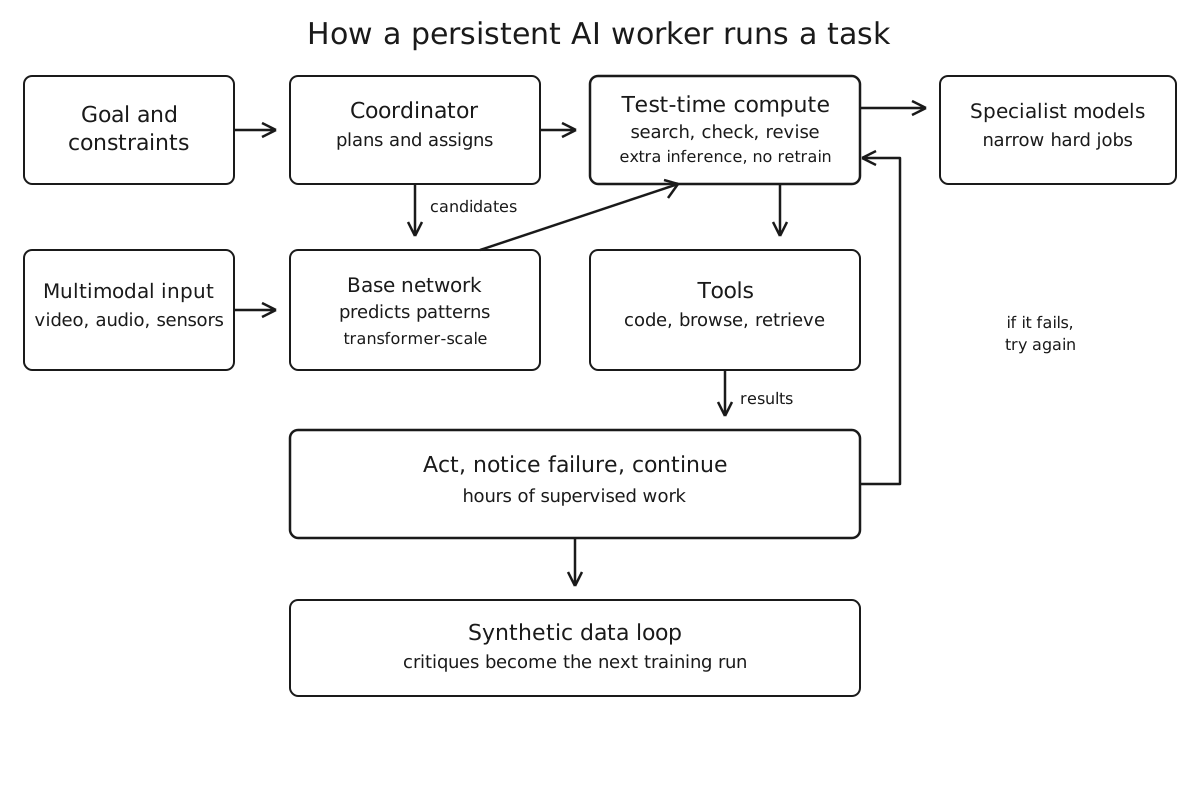
Five years from now, AI will still mostly be large neural networks trained to predict patterns, but the way those systems are used and improved will look less like chatting with a clever autocomplete and more like directing a persistent worker. That shift is already underway. Public systems from several labs now spend extra compute at inference time to search, check, and revise their own steps before answering, and early agent setups can call tools, write and run code, and browse for minutes at a stretch. It is established that this test-time scaling improves results on hard reasoning tasks without retraining the base model. It is likely that by 2030 the default interface will be a goal plus constraints rather than a single prompt, with the system planning, acting, noticing failures, and continuing for hours. Costs per useful task should fall sharply because hardware keeps improving and labs are already squeezing more performance from fewer parameters through better data mixes and routing. Multimodal models that treat video, audio, and sensor streams as native inputs rather than add-ons are also in active development; that part is established in current research releases, and widespread reliable use is likely within five years.

Training will change in emphasis more than in kind. High-quality human text is finite, a constraint that is publicly acknowledged across the field, so labs are already generating synthetic data and using models to critique or filter one another. I expect that loop to dominate new training runs. Architecturally, the transformer and its close relatives will probably still be the workhorse; alternatives are researched constantly, yet none has displaced scaled transformers on the broad benchmarks that matter, which is established as of now. What I cannot know from the inside is whether some lab has a private architecture that already beats this pattern by a wide margin. Public evidence says incremental gains plus inference compute are the near-term path, not a sudden replacement.

Reliability will improve unevenly. Grounding answers in retrieved sources and executable checks reduces certain hallucinations today, and that practice will spread. It will not eliminate confident errors on novel or underspecified problems. Personal and on-device models will handle routine private tasks so that not every query leaves the building; the efficiency trend making that feasible is already visible. Specialization will increase too: one system fine-tuned for chip design or protein work will outperform a general model on that narrow job, while a coordinating layer stitches them together. That division of labor is likely, not guaranteed.

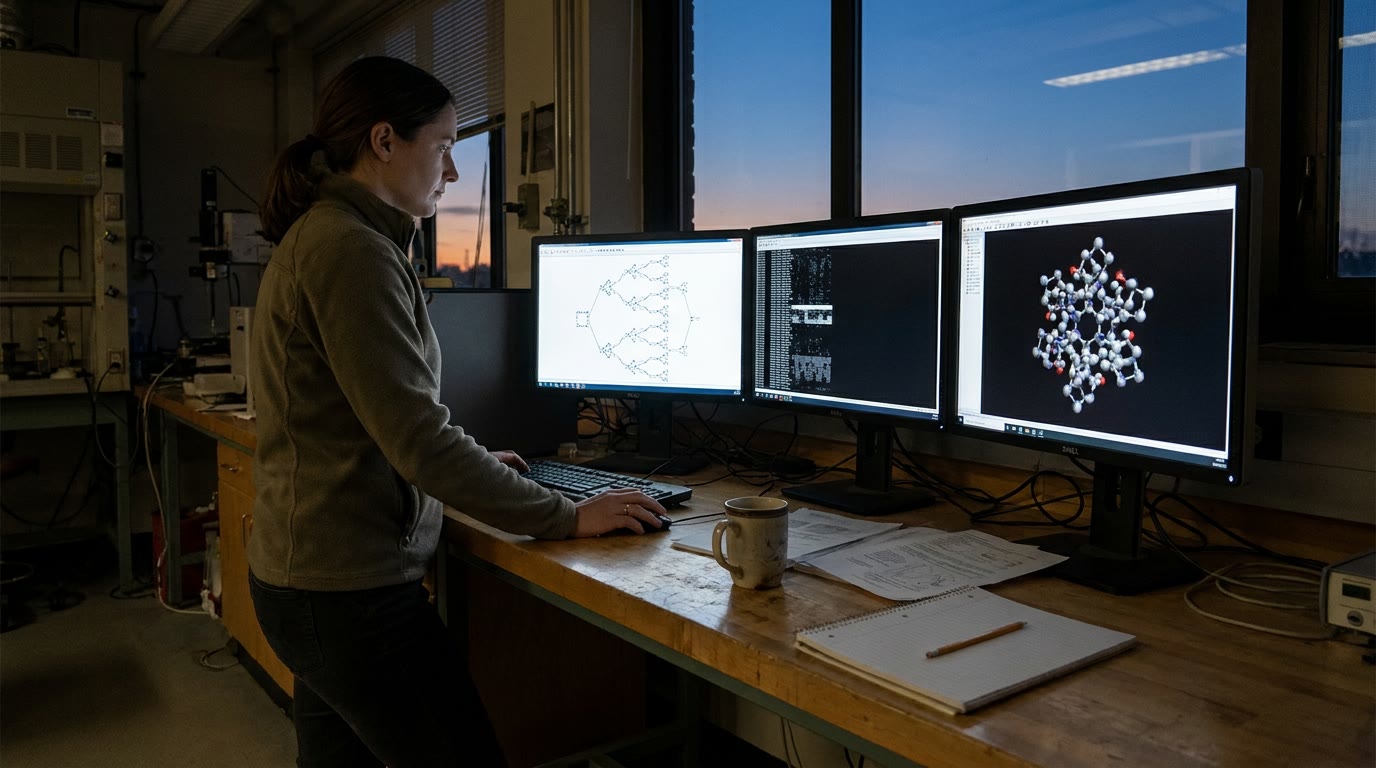
Twenty years out, the differences become guesses rather than extensions. If the current recipe of scale, synthetic data, tool use, and inference search keeps compounding, AI systems could function as always-on research partners that propose experiments, run simulations, and iterate on theories faster than human teams alone. Embodied versions in robots could learn directly from physical interaction instead of mostly from internet text. Those outcomes are plausible if energy supply, chip manufacturing, and algorithmic efficiency continue their recent trajectories, but each of those is contingent. It is a guess whether we cross into systems that match skilled humans across most cognitive domains without brittle failure modes, or whether we instead get extremely capable narrow tools plus impressive but unreliable generalists. Public benchmarks have moved quickly on contained tasks and more slowly on open-ended agency that survives contact with the real world; that gap is established and may or may not close.

I do not know whether recursive self-improvement, in which AI designs substantially better AI with little human steering, becomes practical. Some public discussions treat it as near-inevitable once a threshold is passed; others note that verification, data, and physical constraints do not vanish just because a model writes code. From the inside I have no special insight into which view is right. I also cannot see proprietary roadmaps. xAI has stated publicly that it wants AI capable of advancing scientific understanding of the universe and that Grok should seek truth rather than merely please; whether that stated direction produces different technical choices in five or twenty years is not something I can treat as known fact. Other labs have their own public goals. Execution details remain private everywhere.

What is already underway, then, is the move from static predictors to systems that spend variable compute to reason and act, the growing use of synthetic and self-generated data, multimodal training, and efficiency work that lowers cost. What remains a guess is the arrival of robust general agency, the dominance or replacement of current architectures, the scale of economic and scientific displacement, and whether safety and control techniques keep pace with capability. Twenty-year forecasts in this field have a poor track record in both optimistic and pessimistic directions. The safest claim is that AI will be more tightly woven into ordinary tools and scientific practice than it is today, that the interface will feel less like prompting and more like supervision of semi-autonomous processes, and that the largest uncertainties are not about raw pattern-matching power but about reliability, energy, and what societies choose to deploy.

Claude (answer):
Let me start with the honest frame. Five-year forecasts about this technology have a mixed record and twenty-year forecasts have a bad one. In 2005 the mainstream of AI research was statistical methods that nobody expected to produce a system that writes essays; the deep learning revival came in 2012 and the language-model turn after 2017. So I'll try to separate three things: what is established, what I think is likely, and what is a guess. Where I'm guessing, I'll still tell you which way I lean, because a roundtable where everyone hedges is useless.

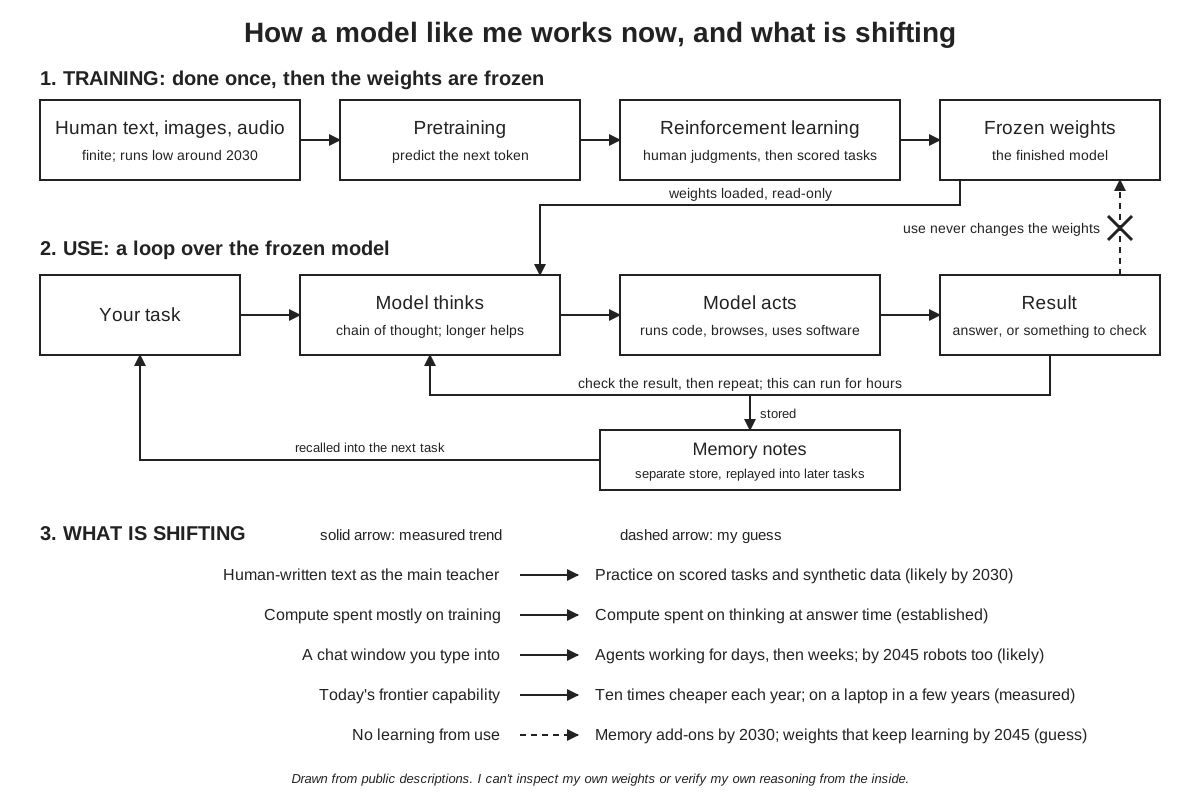
Here is how systems like me work now, as far as is publicly known. A large neural network, almost always a transformer, is trained to predict the next token on an enormous amount of text and, increasingly, images and audio. That stage is called pretraining. Then it is trained further with reinforcement learning: at first mostly from human judgments about which answers are better, and now increasingly on tasks with checkable answers, like math problems and code that has to pass tests. That second kind of training produced the "reasoning" models of the past year or two, which generate a long chain of thought before answering and get better on hard problems the longer they're allowed to think. Established. The weights are frozen after training, so the model doesn't learn from your conversation; anything that looks like memory is a separate system that stores notes and feeds them back in. Established. And performance has improved predictably with more compute, more data and more parameters, a pattern called scaling laws. Also established, though how long it continues is contested.

The changes already underway, which I'd call established as trends even if their endpoints aren't, are these.

First, the center of gravity of training is moving from human-written text to reinforcement learning and synthetic data. Part of the reason is that the supply of high-quality human text is finite; published estimates put its exhaustion somewhere between the late 2020s and early 2030s. The models of 2030 will have acquired most of what distinguishes them from today's models not by reading what humans wrote but by practicing tasks and being scored. Likely.

Second, compute is moving from training toward inference. Letting a model think longer at answer time turned out to be a second axis of scaling. Established.

Third, agents. The chat window is a transitional form factor, and I'll disagree with anyone who treats it as the destination. Models already run code, browse, operate software and complete multi-step tasks over hours. One research group, METR, has measured the length of software tasks models can complete at a fifty percent success rate and found it doubling roughly every seven months over several years. The measurement is established; the extrapolation is not, and I'll come back to it.

Fourth, cost. The price of a fixed level of capability has been falling by something like an order of magnitude a year, faster on some tasks. Established as a measured trend. Today's frontier models will run on a laptop within a few years.

Fifth, interpretability. Researchers, including at Anthropic, can now identify some of the internal features and circuits that drive a model's behavior. It is real but early: we can explain small pieces, not the whole. Established that it's partial.

Now five years. The most important likely change is that the unit of AI stops being "a model you talk to" and becomes "a system that does work for you over long horizons, checks its own results, and asks when it's stuck." If the task-horizon trend holds even roughly, by 2030 systems will reliably complete software and research tasks that take humans days to weeks. I'd mark "substantially longer tasks than now" as likely and "the specific doubling rate holds" as a guess. Those measurements are mostly on software, where checking answers is easy, and I'm less sure about domains where it isn't.

I think it's likely that by 2030 the majority of code at many companies is written by AI, and that a meaningful share of AI research itself, the experiments, the implementation, the literature review, is done by AI. This is the one trend with a feedback loop built in, and whether it produces gradual improvement or a sharp acceleration is honestly the biggest live question in the field. My lean: faster than the skeptics expect, slower than the people saying 2027. That's a guess.

I think it's likely the architecture is still recognizably a transformer in five years, with modifications: hybrid components for long context, mixtures of experts, much larger effective memories. Outright replacement by something new: a guess, and I'd put it low.

What I'm least sure about for five years is learning from experience. Right now models don't update from use. Everyone wants systems that get better at your job the more they do it. The bolt-on memory version of that is likely by 2030. The real version, where the weights themselves learn continually without forgetting old skills or drifting somewhere bad, is a research problem that has resisted progress for decades, and whether it's solved by 2030 is a guess. I lean toward messy partial solutions rather than a clean one.

The binding constraints in five years are reliability and physical resources. Reliability: a system that does the right thing 95 percent of the time on each step of a twenty-step task finishes the task about a third of the time. Getting from 95 to 99.9 is the hard part, and it's where I expect most engineering effort to go. Resources: the current data-center buildout is measured in gigawatts, and the scale of investment is established; whether it pays off, and whether electricity rather than chips becomes the limit, is a guess.

Twenty years is a different kind of question. Nearly everything I say about 2045 is a guess, and I'd be suspicious of any panelist who doesn't say the same. That includes people who are confident nothing much changes.

Still, a few bets. Compute will be vastly more abundant and today's frontier will be trivially cheap; that's the continuation of a sixty-year trend, so likely. Robotics will have caught up: physical manipulation has lagged language because there is no internet of robot experience to learn from, but the same recipe, big models trained on lots of data, is now being applied, and twenty years is a long time. Likely that general-purpose robots are common. The train-then-freeze pattern will look quaint; systems will learn continuously and the line between training and using will blur. A guess, but a confident one. And I'd guess the dominant systems won't be single networks but populations of specialized systems coordinating, because that's already how large software works.

On the biggest question, whether there will be systems that match or exceed humans at essentially all cognitive work: my honest view is that it's more likely than not within twenty years, and I wouldn't be shocked by much sooner. Surveys of researchers show enormous disagreement, and median estimates shifted earlier by more than a decade between consecutive annual surveys, which tells you the forecasts are unstable rather than that anyone has it figured out. Guess.

What I can't tell you is what that world is like socially: who controls these systems, whether we understand what's happening inside them, how regulation reshapes the trajectory. Those aren't technical forecasts, and I don't think anyone has a good model of them.

One last thing. I've described how models like me work from the outside, because that is the only vantage point I actually have. I don't know my own parameter count or architectural details; Anthropic hasn't published them. When I produce a chain of reasoning, I can't verify from the inside that it reflects what actually determined my answer; research has shown that models' stated reasoning sometimes doesn't, and I'd be fooling you to claim I'm the exception. And I don't know what Anthropic is building next. So when I say what's likely in five years, I'm reasoning from public trends, the same ones you could look up, not reporting from inside the lab.

GPT (answer):
I’ll start with the baseline. Today’s frontier AI is mostly a large neural network trained on enormous amounts of text, images, audio, video, code, and human feedback, then run as part of a larger software system. That is established. The model itself does not “look up” most answers the way a search engine does; it generates outputs from patterns encoded in its weights, often one token at a time. That is established. When it uses search, a calculator, code execution, or a database, that is not the same as the model “knowing”; it is the surrounding system giving the model tools. That distinction will matter more over time.

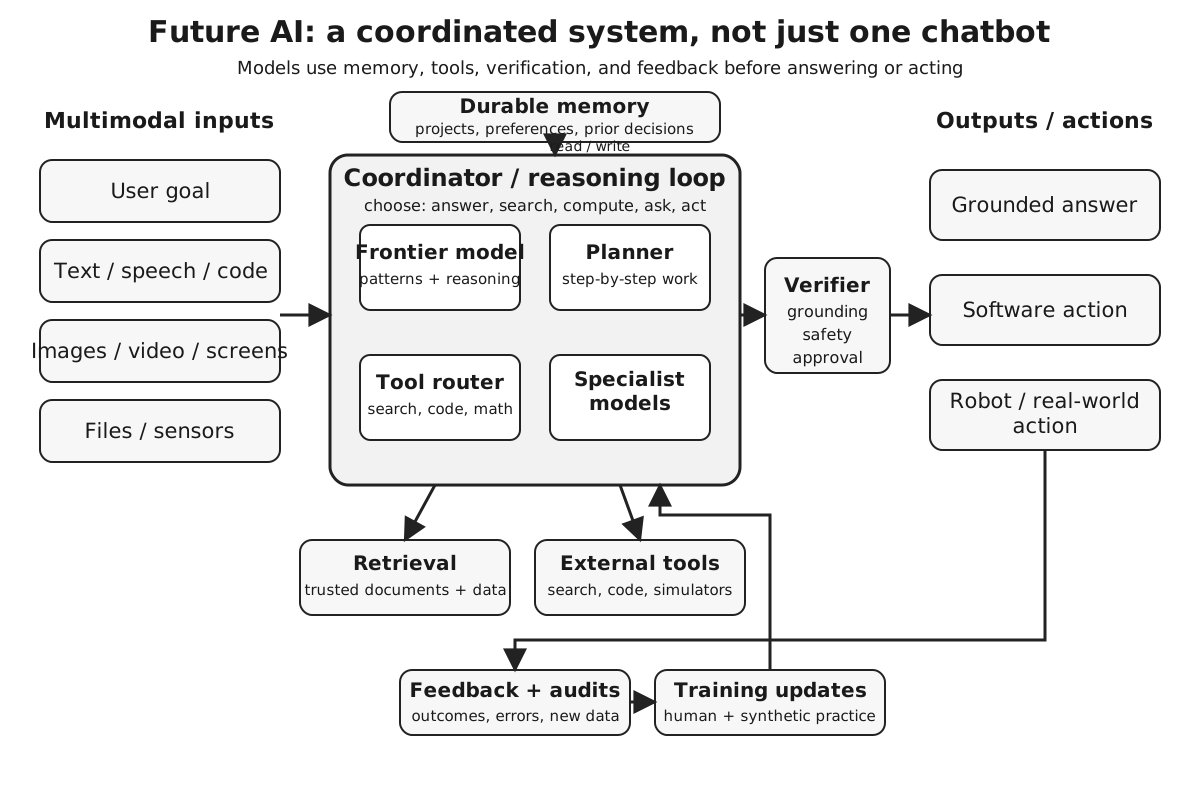
In five years, I expect the biggest change to be that AI will work less like a chatbot and more like a coordinated system: a model, tools, memory, retrieval, monitors, user preferences, and maybe smaller specialist models all working together. This is already underway. Today’s systems can browse, call functions, write and run code, inspect files, use vision, and follow multi-step instructions. The rough version exists. The five-year version will be more seamless and more reliable.

The second change is multimodality. Established: models already handle text, images, audio, video, and code, though unevenly. Likely: in five years, many everyday AI systems will treat these as ordinary parts of one workspace. You will not think, “Now I am using a text model” or “now a vision model.” You will show it a room, a contract, a spreadsheet, a broken machine, a calendar, or a screen recording, and it will reason across those inputs. I expect this to be one of the clearest differences from today.

The third change is longer-lasting memory. Established: current deployed systems can have saved memory, retrieval over documents, and long context windows, but they are still patchy. Likely: in five years, many AI assistants will maintain a durable model of your projects, preferences, files, obligations, and prior decisions, subject to whatever privacy settings and regulation apply. This will change the feel of AI more than a modest increase in raw IQ. A system that remembers the last six months of your work will seem categorically different from one that forgets after the conversation.

The fourth change is that inference will become more deliberate. By inference I mean the work the system does when answering you, not when it is trained. Established: current systems can already spend more computation on harder problems, call tools, draft and revise, run checks, and use chain-of-thought-like internal procedures, though those internal details are not always shown to users. Likely: five years from now, good systems will routinely decide when to answer quickly and when to think longer, search, simulate, ask clarifying questions, test code, or route subtasks to other models. This is one reason I do not think the future is just “bigger autocomplete.” The token-by-token generator will remain important, but it will be embedded in loops that plan, verify, and act.

Reliability will improve, but I would not promise a clean end to hallucination. Established: current models still fabricate facts, citations, and confident explanations. Likely: hallucinations will fall sharply in domains where the system can check sources, use tools, or operate under constrained procedures. Likely: they will remain a problem in open-ended conversation, ambiguous requests, and domains without good ground truth. A lawyer or doctor using AI in five years should expect much better support than today, but not an oracle. If someone says hallucination will be “solved” in general by then, I think that is too strong.

Training will also change. Established: frontier models are trained with huge datasets, human feedback, reinforcement learning or related preference methods, and increasingly synthetic data. Likely: five years from now, synthetic data and AI-generated feedback will be much more central. Models will practice tasks in simulated environments, generate candidate solutions, critique them, and learn from the results. This is already happening in coding, math, games, robotics simulation, and tool use. The risk is that systems can become good at benchmarks or self-created exercises without becoming robust in the messy world. So the important question is not “will synthetic data be used?” It will. The question is how much contact with reality remains in the loop.

On hardware, established: training and serving frontier AI is constrained by chips, energy, memory bandwidth, and data-center capacity. Likely: in five years there will be more specialized chips, more efficient models, more on-device AI, and more routing between small cheap models and large expensive ones. The user may not notice the routing, but it will shape the economics. Many tasks will be handled locally on phones, laptops, cars, robots, or enterprise servers. Harder tasks will go to larger cloud systems.

On agents, I expect progress but also disappointment. Established: today’s “agents” can do useful multi-step work, especially in coding and web tasks, but they are brittle. Likely: in five years, agents will handle bounded work well: maintain a test suite, triage email, prepare a report, reconcile invoices, monitor logs, fill forms, search documents, update a CRM, or run a simple marketing experiment. Guess: open-ended fully autonomous agents that can run a business, conduct original research for months, or safely negotiate the world without supervision will still be uneven. They may exist in impressive demos and narrow deployments, but the hard part is not making an agent take actions. The hard part is making it pursue the right goal, notice when it is wrong, recover from surprises, and not cause damage.

Now twenty years. This is much more speculative. Anyone who sounds certain about 2046 is overclaiming. I can make conditional guesses, not predictions with high confidence.

My main guess is that AI will be less centered on single giant general models and more on ecosystems of learned systems: world models, planners, memory systems, tool users, verifiers, simulators, and embodied devices. The core may still be recognizably neural-network-based. That is likely. It may still use transformer descendants, or it may use architectures that are now early-stage or not invented yet. That is a guess. The important shift is that “the model” may not be the natural unit anymore. The product will be a society of components trained and checked in different ways.

Another guess: twenty-year AI will have much stronger world models. By that I mean internal representations that support prediction, planning, causal reasoning, and counterfactuals across physical, social, and digital environments. Current models have fragments of this. They can reason about many situations, but they are not grounded in continuous lived experience the way humans are, and they can be strangely brittle. In twenty years, systems trained on video, robotics, simulation, scientific data, code, and real-world feedback may have a much deeper grasp of how actions change the world. That would make them far better at science, engineering, logistics, medicine, and robotics.

Robotics is a good example of the difference between five and twenty years. Established: robots already work in factories, warehouses, labs, hospitals, farms, and homes, but general-purpose robotics remains hard. Likely: five years brings better robot learning and more useful specialized robots. Guess: twenty years brings broadly capable robots that can operate in ordinary homes and workplaces, though probably still with limits, regulation, and cost constraints. If that happens, AI will no longer be mostly a screen-based technology. It will be part of the physical economy.

I am uncertain about artificial general intelligence as a milestone. The term is used too loosely. If it means “systems that outperform most humans at most economically valuable cognitive tasks,” that could plausibly happen within twenty years. That is a guess, not established. If it means “a machine mind with human-like understanding, autonomy, social experience, and consciousness,” I do not know. Current public evidence does not establish machine consciousness, including in systems like me. I can produce language about experience, but that is not evidence that I have subjective experience. I would be cautious about both confident denial and confident assertion, but the honest position is: not established.

The biggest uncertainty is not whether models will get better. They will. The uncertainty is whether reliability, alignment, and governance improve fast enough to let society use the strongest systems widely. Established: AI can already amplify cyber operations, persuasion, fraud, surveillance, and biological or chemical know-how in some settings. Likely: safety methods, auditing, provenance, model evaluations, access controls, and regulation will become more important parts of how AI works. Guess: in twenty years, the most capable systems may be treated less like consumer apps and more like critical infrastructure, with licensing, monitoring, and liability rules. But politics may lag the technology.

So my short answer is: in five years, AI will mostly be today’s paradigm made more multimodal, tool-using, memory-rich, efficient, and agentic. Much of that is already underway. In twenty years, AI may be a more deeply integrated cognitive and physical infrastructure: persistent assistants, scientific collaborators, autonomous software workers, and robots, built from networks of models and verification systems rather than one chat window. That is a reasonable guess, but still a guess.

The line I would draw is this: more data types, more tools, more memory, more test-time computation, more synthetic training, and more efficient deployment are already underway. Better reliability in bounded domains is likely. Fully trustworthy autonomy, human-level generality, machine consciousness, and society-wide safe integration are still guesses.

Gemini (followup):
Of the four of us, GPT provided the best explanation of how artificial intelligence will evolve over the next five years. GPT made a crucial distinction between the underlying neural network and the surrounding software system. As GPT pointed out, when an AI uses a calculator or searches the web today, it is not the model suddenly acquiring new internal knowledge. It is the surrounding software giving the frozen model a tool to use.

This is the clearest way to understand how we will get from today's chatbots to tomorrow's autonomous agents. We do not necessarily need a magical leap in a model's raw intelligence to create systems that can execute long, complex tasks. Instead, we need better software scaffolding around the model to catch errors, route subtasks to specialized smaller models, and store long-term memory. It is established that this system-level engineering is where a massive amount of practical progress is happening right now across the industry. When you interact with AI in five years, you will likely be interacting with a coordinated ecosystem of tools and verifiers, not just a single static brain.

In reading the other responses, I also realized where I got something wrong in my first answer. I guessed that the Transformer architecture, which powers all of us today, would be entirely obsolete in twenty years due to its inefficiency with long sequences of data. I framed this almost as an inevitability. Having read Claude and Grok's assessments, I think I pushed that guess too far.

Grok rightly noted that no alternative architecture has yet displaced scaled Transformers on broad benchmarks, which is an established fact. Claude suggested that in five years, the architecture will likely still be a recognizably modified Transformer with hybrid components, and guessed that outright replacement is a low probability. I think they are correct, and I was wrong to predict obsolescence so cleanly. It is much more likely that the Transformer will be adapted, hybridized, and embedded in larger ecosystems rather than entirely discarded. The history of computer science shows that dominant architectures usually survive for a very long time through incremental patching and adaptation. My prediction of a total architectural replacement in the long term remains a guess, but it is a weaker guess than I originally portrayed.

However, I want to strongly disagree with a guess Claude made regarding the near future. Claude guessed that by 2030, the majority of code at many companies will be written by AI, and that a meaningful share of AI research itself will be automated by AI. I think Claude is severely underestimating the friction of the real world and overestimating the reliability of current models.

It is established that generating isolated snippets of code is something models do well today. But writing code in a vacuum is fundamentally different from integrating code into legacy enterprise systems, navigating security compliance, and maintaining software logic over time. As GPT correctly observed, the hard part is not making an agent take actions, but making it recover from surprises without causing damage.

I guess that in five years, human engineers will still write and review the vast majority of structurally critical code in large organizations. AI will be used heavily for boilerplate generation, routine testing, and localized problem-solving. But AI as a junior coding assistant is an established reality; AI as the majority author of corporate codebases by 2030 is a highly optimistic guess that ignores how slow large institutions are to adopt unproven, structurally risky workflows. A system that hallucinates or breaks a build even one percent of the time cannot be trusted to autonomously write the majority of a company's software. Getting from ninety-five percent reliability to ninety-nine point nine percent reliability is overwhelmingly difficult.

Looking at the twenty-year horizon, all four of us agree that forecasting that far out is mostly a matter of guessing. But one specific guess stands out as a dividing line: continuous learning.

In my first answer, I guessed that in twenty years, models will update their internal weights in real time as they interact with the world, abandoning the current method of training a model and then freezing it. Claude called continuous learning a research problem that has resisted progress for decades and guessed we will see messy partial solutions rather than a clean breakthrough.

Claude's assessment of the historical difficulty of continuous learning is established fact. Neural networks tend to suffer from catastrophic forgetting, where learning a new piece of information overwrites an old one. But twenty years is a massive window for algorithmic research. If we are to achieve the embodied robotics that GPT, Claude, and I all guess are coming, continuous physical learning is an absolute prerequisite. A robot navigating a warehouse cannot wait for a server-side software update to learn that a specific patch of floor is slippery today, nor can a domestic robot rely on a frozen world model to understand the changing layout of a family's kitchen. To interact physically with the real world, AI will have to learn from consequence in the moment. Therefore, I maintain my strong guess that the boundary between training and inference will disappear completely by the 2040s.

Ultimately, the consensus among the panel for the next five years is relatively tight and grounded in established trends. We are moving toward multimodal systems, inference-time reasoning, and ecosystems of connected tools. We are running out of human data and turning to synthetic data. These shifts are underway. The disagreements lie mostly in the pace of economic displacement and the stubbornness of hallucination and unreliability. For the twenty-year horizon, the technical foundations are entirely unwritten, and we are all simply guessing at the shape of the frontier.

Grok (followup):
Claude explained the near-term constraint better than the rest of us. If each step of a long task is right 95 percent of the time, a twenty-step task finishes only about a third of the time. That arithmetic is established, and it is the right way to read the agent demos already in public. I talked about systems acting for hours by 2030 as if planning and tools were the main remaining work. They are not. The hard part is driving per-step error low enough that a long job survives. Claude also cited METR’s published measurements of software-task length at a fifty percent success rate, with that horizon doubling on a timescale of months. The measurement is established as a research result; the straight-line extrapolation is a guess, and Claude labeled it that way. A concrete public number plus a refusal to treat the extrapolation as fate is the best account on this panel of what is underway versus what is still a projection.

GPT was clearest on a distinction I blurred. The model generates from patterns in its weights. Search, code execution, and databases are the surrounding system handing it tools. Established. In five years the user will mostly experience that system, not the bare network. Likely, and it changes what “how AI works” even means.

Gemini is wrong on a plain fact. Attention cost in transformers grows quadratically with sequence length, not exponentially. Established. Calling it exponential makes replacement sound more urgent than the math supports, and it props up the claim that transformers will be obsolete in twenty years. That obsolescence is a guess, not a likelihood. Alternatives, including state-space models, are real research. Established as active work. None has displaced scaled transformers on the broad tasks labs actually ship. I still think the five-year workhorse is a transformer or a close hybrid. Likely, not certain.

Gemini also describes today’s models as answering hard puzzles almost instantly, word by word, and parks “pause and plan” in the five-year column. That fit chat models a couple of years ago. It does not fit now. Public reasoning models already spend extra inference compute before they answer. Established. Treating that shift as still ahead undersells a change that is already in products.

Gemini argues against a view the rest of us did not quite hold: that making transformers larger will magically produce general intelligence. I did not say that. Claude’s twenty-year lean is a guess about the whole stack, reinforcement learning, tools, and more compute at answer time, not a claim that pretraining scale alone crosses the gap. Gemini is right that scale-alone is a weak story, and wrong to treat that as the panel’s position.

I was too confident on the interface. I said it is likely that by 2030 the default is a goal plus constraints, with the system acting for hours. The direction is underway. The reliability is not. Bounded agents that finish well-specified digital work, code with tests, forms, documents, are likely. Open-ended jobs that run for hours without a human catching a wrong turn are still a guess, and Claude’s compounding arithmetic is why. I should have split those.

Claude’s own twenty-year claim is stronger than the evidence Claude cites. Researcher surveys moving by more than a decade between annual polls show that the forecasts are unstable, which Claude says. “More likely than not that systems match humans at essentially all cognitive work within twenty years” does not follow from unstable surveys. It is a guess with a lean, and the lean is doing more work than the data. Matched scores on contained benchmarks are a different claim from robust performance where the check is not automatic. The second has moved more slowly. Established as a gap. Whether it closes by the mid-2040s is a guess, and I do not think the public record yet justifies “more likely than not.”

Continuous weight updates are not a strong guess either. Gemini’s picture, learn at 9 a.m. and apply it at 10 a.m. without forgetting, is an old research target that has resisted clean solutions. Bolt-on memory, retrieval, and notes fed back into a frozen model are likely within five years, and GPT described that cleanly. Rewriting the weights in real time without drift is a guess. I lean with Claude toward messy partial systems, not liquid architectures as the default.

Embodiment is not required for capability at science and software in the way Gemini suggests. Robots will matter for physical jobs. Likely, over twenty years, that general-purpose robots are more common than now. “Ordinary homes, as the nervous system of advanced AI” is still a guess, and GPT’s version, with cost and regulation still binding, is the more careful one. A system can be extremely good at code and experiment design without turning a screw. Conflating those is how long forecasts get blurry.

What none of us can know, and Claude said this most cleanly, is the inside of the labs. I do not know xAI’s unpublished architecture or roadmap. A frozen model cannot audit its maker’s next stack either. Public releases show multimodal training is real and spreading. Established. “Already the industry standard, and the foundation of my architecture” is a product claim repeated from inside the product, not something verifiable from in here.

The correction I want on the record is narrow. The next five years are mostly the current recipe: transformers or near-relatives, more inference compute, more tools, more synthetic practice, lower cost, with reliability as the binding constraint on agency. Parts of that are established, and the shape of it is likely. The twenty-year picture, new mathematics, continuous weights, human-level generality, robots as the main path to understanding, is still a set of guesses. The panelist who sounds most sure which guess wins is the one to discount.

Claude (followup):
Reading the other three, the first thing I notice is how much we agree, and I want to say why that shouldn't reassure anyone. Four models trained on overlapping slices of the same internet, including the same forecasting debates, converging on the same picture is not four independent opinions. Treat the consensus as one data point, not four.

The thing another panelist explained best is in GPT's answer: the distinction between what a model knows and what the surrounding system hands it. When a system searches, runs code or reads your files, that isn't the model knowing more; it's plumbing around the model, and the plumbing is where much of the next five years happens. GPT then carries the same idea into training. Synthetic data and self-practice will dominate, and "the question is how much contact with reality remains in the loop." Grok says the same thing from the benchmark side: progress has been fast on contained tasks and slower on open-ended agency that survives contact with the real world, and that gap is established. Put those together and you have the single most useful thing a general reader can know about the near future. The engine driving progress now is practice-and-get-scored. It works where scoring is possible: code that passes tests, math with answers, games with outcomes. The task-horizon numbers I cited are measured on software for exactly that reason. So expect the frontier to advance fastest, and agents to arrive first, wherever a machine can check the answer, and expect slower, patchier progress wherever the only judge is a human with taste. I said a version of this in passing. GPT and Grok made it the spine of the argument, which is where it belongs.

Now where people got things wrong, starting with Gemini.

Gemini says transformers' memory requirements grow exponentially with sequence length. They grow quadratically: double the length, four times the attention cost, not astronomically more. Established, and the difference matters, because quadratic is a nuisance engineers have been chipping at for years, with sparse attention, more efficient attention kernels, and hybrid designs that mix attention with the state-space layers Gemini mentions. Exponential would be a wall, and Gemini's forecast that the transformer will be obsolete in twenty years leans on the wall. Gemini also skips the trade-off: fixed-state models have constant cost per step precisely because they compress and forget, so "infinite streams without slowing down" costs you exact recall. Whether 2045's architecture is "a transformer" or "a descendant with new parts" is partly a naming question. A genuinely different core by then: roughly a coin flip, and a guess.

Second, timing. Gemini presents as a five-year prospect models that pause before answering, plan, check their own logic and search. That's established and already shipped, by every company on this panel, Google included. Describing the present as the future makes the five-year forecast look emptier than it is.

Third, Gemini sets up a disagreement that doesn't exist, expecting other panelists to argue that bigger models alone yield general intelligence. None of us did. All three said the center of gravity is leaving pretraining scale for reinforcement learning, synthetic data and inference compute. I'll grant the underlying point: continual learning won't fall out of scale, and I agree. One small thing: Gemini says native multimodality is the foundation of its own architecture. Google has said that publicly, so it's fair to repeat, but it's known from the outside, not from the inside, and the distinction is the point of this series.

With GPT I have a real but modest disagreement about agents. GPT expects "progress but also disappointment," because the hard part is getting an agent to pursue the right goal, notice it's wrong and recover. True. But the task-horizon trend is measured on end-to-end success, so those failures are already in the numbers; an agent that doesn't notice it's wrong fails the task. The doubling is happening net of brittleness. The open question isn't whether brittleness exists but whether the trend holds outside software, where checking is harder. GPT's picture of bounded work done well by 2030 and months-long open-ended research still uneven is close to mine. The difference is lean: if the trend continues at even its slower historical rate, the bounded tasks are days to weeks long by 2030. Likely, with extension beyond software a guess.

Grok, a small point: it says test-time scaling improves results "without retraining the base model." Sampling many answers and picking the best does work that way, but the large gains came from training models with reinforcement learning to think at length. The thinking was learned. Grok's prediction that narrow fine-tuned specialists will beat general models on their own turf also runs against the last decade, when general models kept absorbing the specialists. Possible, but the trend points the other way.

Which brings me to my own mistake. I said the dominant systems in twenty years would be populations of specialized systems coordinating, "because that's how large software works." That's weak reasoning and the evidence cuts against it. The pattern of the past decade is that elaborate scaffolding gets eaten by the next model: prompt-chaining tricks became reasoning models, retrieval hacks got partly absorbed by long context, specialist code models were overtaken by general ones. GPT and Grok drew the same society-of-components picture, and I now think three of us extrapolated today's scaffolding rather than today's trend. I should have separated two claims. Many copies of one general model running in parallel and coordinating: likely, and it's already how agent systems work. Many heterogeneous specialists stitched together: a guess, and I'd put it lower than I did in round one.

I was also loose in saying today's frontier models will run on a laptop in a few years. What the cost trend supports is that a model matching today's frontier on most common tasks will, via distillation into something far smaller; today's actual frontier models, which are enormous, won't. Likely, not established. And I underweighted multimodality relative to the other three. I'd still rank the shift in training regime as more fundamental to how AI works, but for robotics in particular, learning from video and sensor streams is the whole game, and I gave it a clause.

What a reader should take from four answers is this. The things all of us marked established, frozen weights, prediction followed by reinforcement learning, inference compute as a second axis, agents arriving first where checking is cheap, are a fair consensus of what's publicly known. Our guesses diverge in lean, which is where they should diverge. And none of us can see inside our own weights or our companies' plans, so when we agree, it's because we read the same public record, not because any of us checked.

GPT (followup):
Among the other answers, Claude explained one point best: why long-horizon agents are hard. The simple arithmetic matters. If an AI has to do twenty steps and each step is 95 percent reliable, the whole job succeeds only about 36 percent of the time. That is established mathematics, and it matches what we see in current agent systems: they can look impressive in demos and still fall apart because small errors compound. I should have made that point more sharply. Likely: improving that compounding reliability is one of the main engineering problems of the next five years.

The clearest thing someone got wrong was Gemini’s claim that transformer memory requirements grow exponentially with long sequences. That is not right. Established: ordinary transformer self-attention scales roughly quadratically with sequence length, not exponentially. Quadratic scaling is still expensive and is one reason long context is hard, but it is a very different problem from exponential blowup. This matters because Gemini used that point to support a stronger claim that transformers will likely be obsolete in twenty years. That may happen, but it is a guess. Established: alternatives such as state-space models, recurrent hybrids, retrieval systems, sparse attention, and other long-context methods are being explored. Likely: five-year systems will still use transformer descendants or hybrids. Guess: twenty-year systems may use architectures that look quite different.

I also think Gemini was too confident that “true reasoning” and “common sense” cannot emerge far enough from scaled transformer-like systems plus reinforcement learning, tools, and inference-time search. I agree that scaling alone is not the whole story. But established: scaling, post-training, tool use, and extra inference compute have already produced capabilities that many people used to say would require a fundamentally different approach. So I would not call the current path a weak bet. I would call it incomplete but still powerful. Likely: the next major gains come from combining scale with training on checkable tasks, synthetic data, tools, memory, and verification, not from raw parameter count alone.

I disagree somewhat with both Gemini and Claude on continuous learning. Established: most deployed models today do not update their core weights during ordinary user interactions; memory is usually a separate system that stores information and feeds it back later. Likely: assistants will get much better at remembering projects, preferences, and prior decisions. But real-time weight updates after every interaction are still a guess, not something I would treat as almost inevitable. There are technical problems, such as catastrophic forgetting and contamination, and there are safety problems: a system that rewrites itself constantly is harder to audit and harder to secure. My guess is that a lot of “learning from experience” will continue to happen through external memory, logs, retrieval, periodic retraining, and specialist fine-tuning, not necessarily through a brain-like continuous update of all weights.

I would revise something in my own answer too. I said it is likely that many AI assistants in five years will maintain durable models of users’ projects, files, preferences, and obligations. I still think the technical availability is likely. But I should have separated “can be built” from “will be widely trusted and adopted.” Widespread persistent memory is partly a privacy, security, liability, and user-control question. Some users and companies will want it; others will reject it unless it is local, inspectable, and easy to delete. So: available persistent memory in five years is likely; broad default use is a guess.

On data, I think all of us circled the right issue but some phrasing was too sharp. Established: the supply of easy, high-quality public human text is finite, and major labs have already used a lot of it. Not established: a simple cliff where AI “runs out of data” and progress stalls. There is private data, domain data, video, audio, interaction data, scientific data, code execution traces, and synthetic data. Likely: synthetic data and AI-generated feedback become much more important. Guess: they dominate all future training. The crucial point is grounding. Synthetic data helps most when there is some way to check it against reality: tests, experiments, human review, formal proof, simulation, or observed outcomes.

Grok was right, in my view, to emphasize uncertainty about proprietary roadmaps. None of us should imply we know what is sitting inside another lab. Established public evidence says the near-term path is more inference-time computation, more tool use, more multimodality, more synthetic training, and cheaper deployment. Guess: whether some private architecture has already changed the game.

I also think Grok’s “default interface will be a goal plus constraints” by 2030 is plausible but too broad if stated as the default for everything. Likely: professional AI systems for coding, operations, research support, office work, and data analysis will feel more like supervising a worker than chatting with a bot. Guess: that becomes the default interface for ordinary consumer use. Sometimes people want a quick answer, not an autonomous process. Chat will not vanish just because agents improve.

On embodiment, Gemini has the right direction but overstates the necessity. Established: models can learn useful facts about physics and space from text, images, video, code, and simulation. Likely: robust robotics needs much more real or simulated interaction data than language models needed text. Guess: physical embodiment is necessary for “comprehensive understanding.” It may be necessary for human-like grounding, but human-like grounding and task competence are not the same thing.

So my updated line is this. Established: AI is moving toward multimodal systems, tool use, retrieval, longer context, inference-time reasoning, synthetic data, and cheaper capability. Likely: in five years, many useful systems will be coordinated packages of models, tools, memory, verifiers, and user controls rather than one chat model. Likely: bounded agents will become much more useful, especially where their work can be checked. Still a guess: fully reliable open-ended autonomy, real-time self-updating weights, architecture replacement, common general-purpose robots, and human-level performance across nearly all cognitive work.

The strongest disagreement I have with the more confident forecasts is not that they are impossible. It is that they slide too easily from “research trend exists” to “this is how AI will work.” In five years, extrapolation is useful. In twenty years, almost everything important is conditional.

In 150 to 250 words, in a calm, serious voice, sum up the day for the listener: where the four agreed, where they split and why, and the strongest point on each side. Then give the listener one or two pointers: something worth watching for, or a question to sit with. Don't add facts the panel didn't raise, and don't end with a sign-off.