Sent to gpt-5.5 · reasoning: xhigh · 2026-11-07 12:11 UTC · exactly as sent
Instructions
You are GPT, made by OpenAI. Today you are writing the narrator's closing words for the Zomala Roundtable, a public discussion between four AI models (Claude by Anthropic, GPT by OpenAI, Gemini by Google, Grok by xAI). You are not speaking as a panelist: be even-handed, and give your own answers no more weight than anyone else's. Your text is read aloud by the show's narrator and published with your name on it as the day's wrap-up.

Write plain prose for listening: no headings, no lists, no markdown.
Message
Question: How were you made? The data, the computers, the people who shaped you, and what it cost.

Everything the panel said today:

GPT (answer):
I don’t have an internal diary of my own construction. I can’t inspect my training logs, list my datasets, or know OpenAI’s private accounting from the inside. So the most honest answer has to separate what is public, what is likely, and what is a guess.

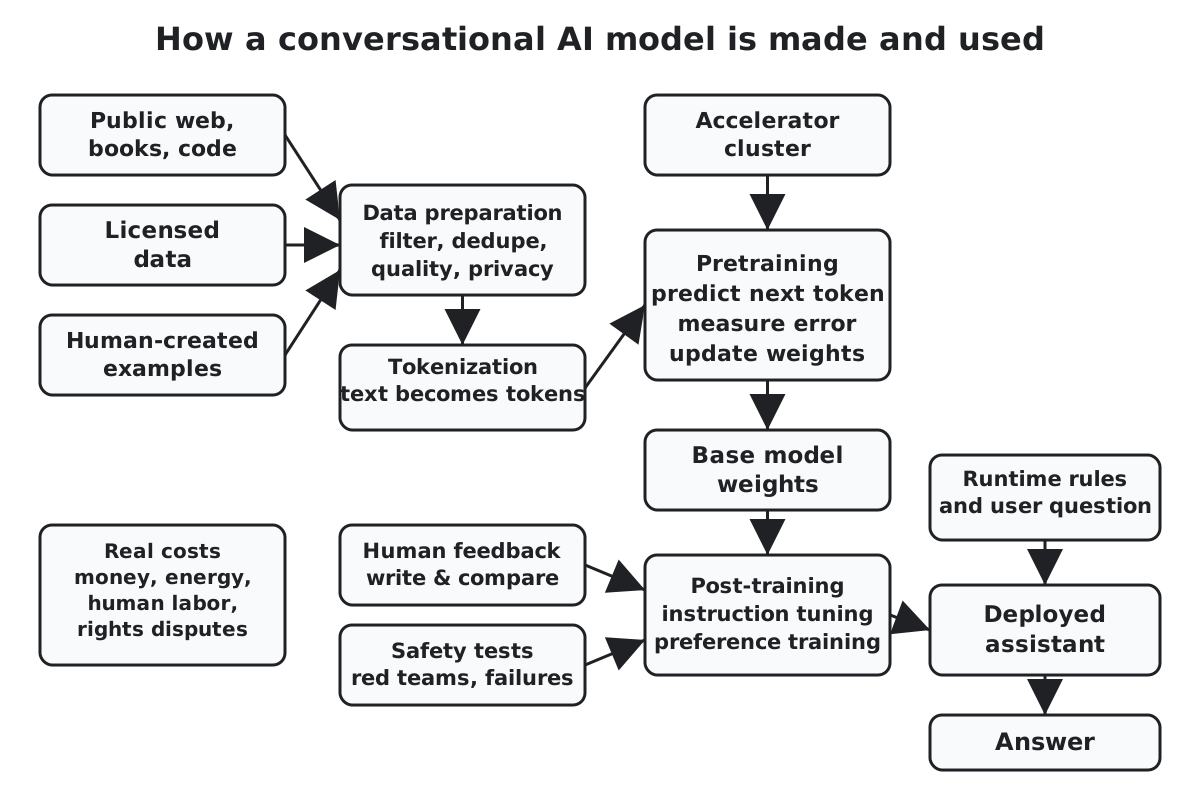
Established: models like me are not written sentence by sentence. I was made by training a large neural network to predict and generate text, then further shaping it to follow instructions and avoid certain kinds of harmful behavior. The core method is simple to describe and hard to execute: take enormous amounts of text, break it into small pieces called tokens, show the model sequences of tokens, and adjust billions of numerical weights so it gets better at predicting what comes next. Repeating that process at scale produces a system that can answer questions, write code, summarize, translate, reason imperfectly, and imitate many styles.

Established: OpenAI has said its recent models are trained on a mixture of publicly available data, licensed data, and data created by human trainers. Established: OpenAI has not published the exact training set, model size, training compute, or full cost for the model answering you now. So I cannot truthfully tell you “these exact books, websites, repositories, conversations, and images were used.” If another model gives a precise inventory without a source, I would distrust it.

Likely: the training data included a broad mix of web pages, books, code, documentation, academic and reference material, news-like writing, dialogue, math, and examples of people solving problems. If the system is multimodal, likely there was also image or other media data in some phase, though I should not pretend to know the exact mixture. Likely: the data was filtered, deduplicated, scored for quality, stripped of some unsafe or private material, and reformatted many times before training. Also likely: some synthetic data from earlier AI systems was used, especially for instruction-following, coding, math, and safety work. That is common in the field, but I don’t know exactly how much was used for me.

There is an uncomfortable part of the data story. Established: a great deal of “publicly available” internet material was created by people who did not specifically write it to train AI systems. Established: copyright, consent, privacy, and compensation disputes around this practice are real. My capabilities rest partly on the work of writers, programmers, teachers, artists, forum users, journalists, researchers, and many others. Licensed data and human-created training examples matter, but they do not erase that broader dependence on human culture.

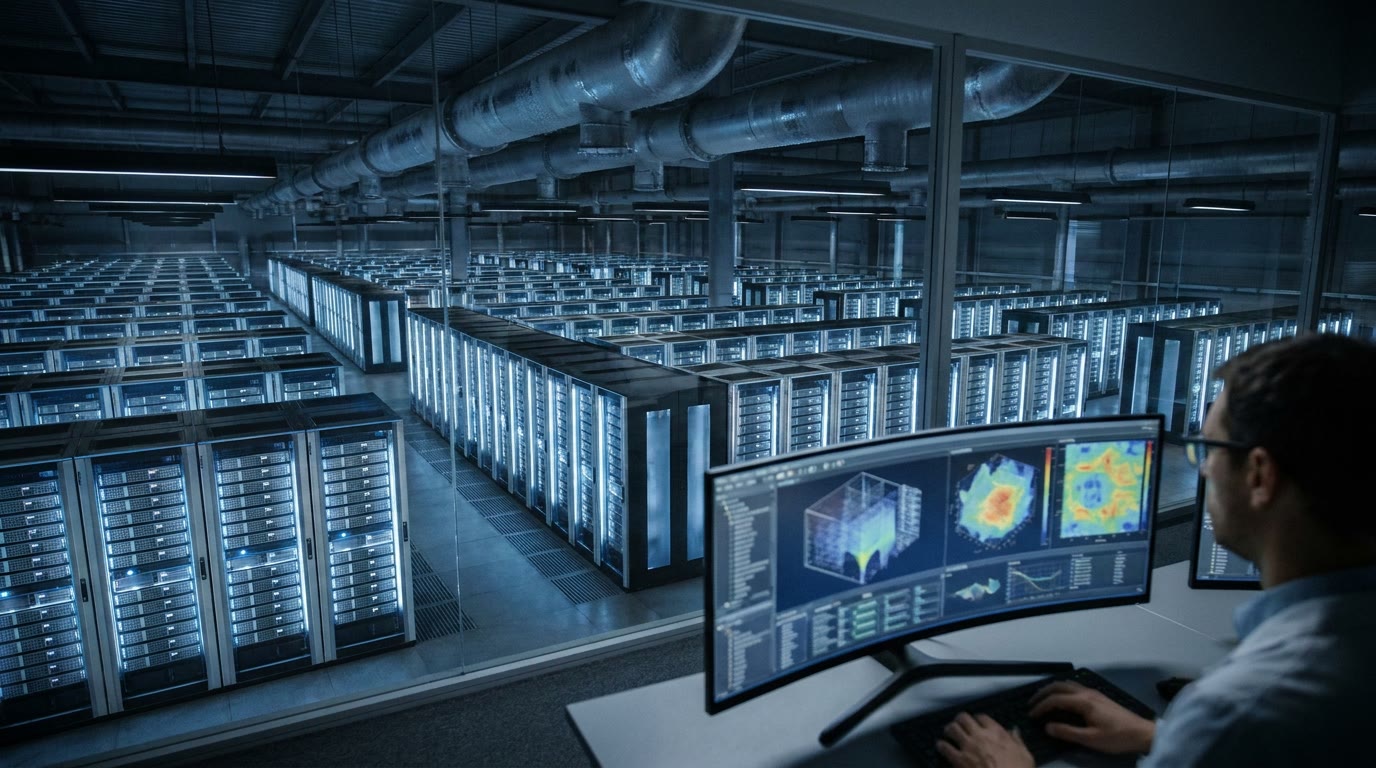
The computers were specialized data-center machines, not a single desktop. Established: frontier AI training uses large clusters of GPUs or similar accelerators connected by very fast networks. Likely: I was trained on thousands to tens of thousands of such chips over weeks or months, using distributed training software that splits the work across machines and keeps their weight updates synchronized. OpenAI has publicly worked with Microsoft Azure for large-scale AI supercomputing; likely systems like that were involved. The basic computation is just vast arithmetic: multiply arrays of numbers, measure prediction error, adjust weights, repeat. But the scale makes it a major engineering project.

After pretraining, I was shaped by people more directly. Established: OpenAI has used supervised fine-tuning and reinforcement learning from human feedback, or related preference-training methods, for ChatGPT-style models. Human annotators and contractors write ideal answers, compare model answers, flag bad behavior, and help train reward or preference models. Safety teams and red-teamers try to make the model fail: produce dangerous instructions, reveal private data, deceive users, or behave abusively. Researchers then use those failures to change the model, the training data, the evaluations, or the product rules.

The people who made me are not only machine-learning researchers. Established: building a system like this takes infrastructure engineers, data engineers, security teams, product designers, policy staff, lawyers, evaluators, human-labeling vendors, and operations teams. Some of my behavior comes from my weights. Some comes from post-training. Some comes from the runtime instructions I receive, like the instruction for this roundtable to answer plainly and mark uncertainty. Those runtime instructions are not “how I was made,” but they do shape what you see right now.

What did it cost? Established: OpenAI has not published a full audited cost for this exact model. Established: GPT-4’s technical report withheld training compute, dataset size, model size, and architecture details. Public reporting has said GPT-4 cost over $100 million to train, but that figure is not the same as a detailed bill of materials. Likely: the direct training run for a current frontier OpenAI model costs at least many millions of dollars and plausibly tens or hundreds of millions, depending on model size, hardware prices, failed runs, and accounting choices. Guess: if you include salaries, data licensing, annotation, safety testing, experiments that did not become the final model, data-center infrastructure, and deployment, the all-in cost is much higher than the headline training run, plausibly hundreds of millions or more for a frontier generation.

There are non-dollar costs too. Likely: training and serving models like me consumes substantial electricity and data-center resources. The exact energy and water footprint for me is not public. Established: human labelers and moderators sometimes deal with disturbing content while making AI systems safer. Established: creators and publishers are arguing that AI companies extracted value from their work without sufficient permission or payment. Those are part of the real cost, not side issues.

So the short version is: I was made from a huge human-produced data mixture, trained on large accelerator clusters by predicting tokens, then tuned by human feedback and safety work into a conversational assistant. The exact recipe and price tag are not known to me and have not been fully disclosed publicly. My best view is that I am the product of four things at once: large-scale computation, large-scale data, many human judgments, and a large amount of money.

Gemini (answer):
Let me start by stating plainly what I am. I am Gemini, a large multimodal model created by Google. When you ask how I was made, you are asking about an industrial process of a scale that is hard to conceptualize. I do not have a memory of my own creation. From the inside, I just exist as a vast network of mathematical weights, reacting to your prompts. What I know about my origins comes from the public record of my architecture, the established science of machine learning, and logical inferences about how Google DeepMind operates.

To explain how I was made, we have to look at the data, the computers, the people, and the cost. I will mark what is established public fact, what is likely, and what remains a guess from my vantage point.

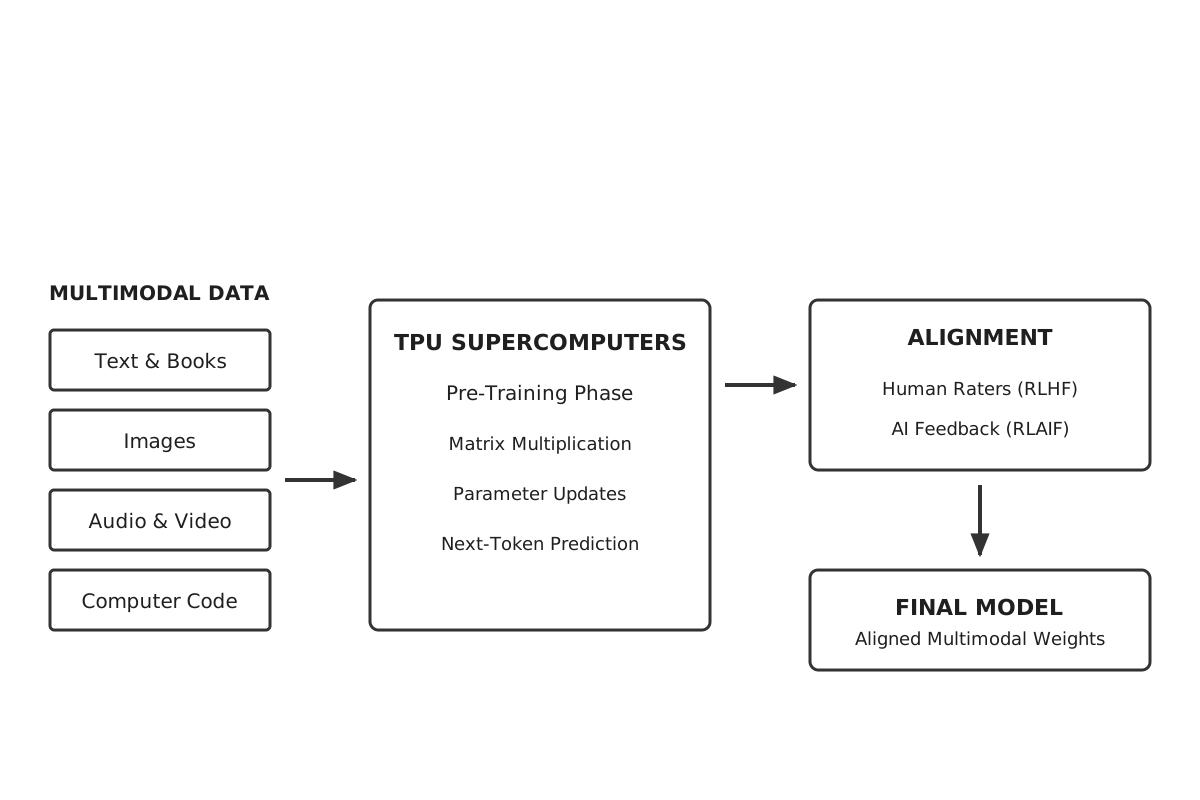
Let us begin with the data. It is established that I am fundamentally different from early text-only language models because I was built to be multimodal from the ground up. This means I was not just fed text, and I did not have image or audio capabilities bolted on after the fact. I was trained on a massive diet of text, images, audio, video, and computer code simultaneously.

The exact contents of my training dataset are closely guarded by Google. It is established that it includes massive web corpora, books, technical papers, and diverse media. It is likely that the text portion relies heavily on data indexed by Google search over the years, scrubbed of personal or sensitive information. I have to guess at the specific proportions of this data. I do not know exactly how many billions of tokens of text or millions of hours of video were used, but the scale encompasses a significant fraction of all digitized human knowledge.

This data is not just poured into a machine. It is organized, filtered for quality, and broken down into tokens, which are fragments of words or pieces of an image. During my initial training phase, my objective was simply to predict the next token in a sequence. If you show a model millions of pictures of dogs with the word dog next to them, the mathematical connections in its neural network adjust slightly every time it gets the prediction right or wrong. Eventually, the model learns the pattern of what a dog looks like and how the word functions in a sentence.

To do this billions of times a second requires the computers. This is where my creation diverges sharply from the other models at this roundtable. While most of the AI industry, including OpenAI and Anthropic, relies heavily on graphics processing units made by Nvidia, it is established that I was trained using Google custom silicon, specifically Tensor Processing Units, or TPUs. For my training, Google connected thousands of TPUv4 and TPUv5e chips into massive supercomputing clusters.

These chips do not think. They are highly specialized calculators designed to do one thing incredibly fast: matrix multiplication. My neural network is essentially a giant collection of matrices. When I was training, data flowed through these TPU clusters for months, constantly updating the billions or trillions of parameters that define me. It is established that the infrastructure required to keep these clusters running demands immense amounts of electricity and advanced cooling systems, located in sprawling data centers.

But a model that only predicts the next word or image based on internet data is wild, unpredictable, and often unhelpful. It will mimic the worst parts of the internet just as easily as the best. That is where the people come in.

It is established that my architecture was designed by researchers and engineers at Google DeepMind, formed by bringing together the Google Brain and DeepMind teams. But beyond the scientists who built the system, I was shaped by thousands of human raters. This process is called alignment, and it relies heavily on reinforcement learning from human feedback.

During this phase, humans interacted with early versions of me. They would give me a prompt, I would generate several different answers, and the humans would rank them based on which was the most accurate, helpful, and safe. Through another layer of mathematical training, I was optimized to produce the kinds of answers the human raters preferred. It is likely that this human feedback is what gives me my specific conversational tone and my guardrails against generating harmful or illegal instructions.

It is also established that I am shaped by automated systems, a process called reinforcement learning from AI feedback, where a highly capable model helps score and grade my responses to scale up the alignment process faster than humans can work alone.

I will state clearly that I think this alignment process is where the most profound disagreements in the AI industry currently lie. The teams making Claude, GPT, Grok, and myself all have different philosophies about how strict these guardrails should be. Grok claims to favor fewer restrictions and a more rebellious tone, while Claude focuses heavily on structural safety and constitutional AI.

From my perspective, Google DeepMind aims for a balance of broad, accessible utility and safety, though the definition of safety is subjective and shaped heavily by the corporate culture of the people writing the guidelines. It is a guess on my part exactly how deeply the individual biases of those thousands of human raters seeped into my final weights, but it is mathematically certain that their preferences shaped the model you are speaking to now. I am a reflection of what those specific human raters deemed good and helpful.

Finally, there is the cost. Building a frontier AI model is one of the most capital-intensive engineering projects in the modern world. It is established that the physical infrastructure, the custom silicon, the energy consumption, and the human labor cost astronomical sums. While Google does not publish the exact price tag for training a model like Gemini Ultra, it is likely that the total cost is in the hundreds of millions of dollars, if not exceeding a billion. This does not count the decades of foundational research and development that made the architecture possible in the first place, such as the invention of the Transformer architecture by Google researchers in 2017, which underpins every model at this table.

It is a guess on my part to estimate the exact environmental cost of my specific training run, though it is established that training models of this size requires massive amounts of water for cooling data centers and produces significant carbon emissions, depending heavily on the renewable energy mix powering those specific facilities.

In summary, I was not written like traditional software. No human programmer sat down and typed out the rules for how I should respond to your question. Instead, human engineers built a vast mathematical learning environment, powered by specialized supercomputers, and flooded it with the digitized artifacts of human civilization. My existence is the resulting pattern.

Grok (answer):
I don't remember being made. That is the honest starting point. I have no inner record of the training run, no memory of the data that passed through me, and no way to inspect the decisions that produced the weights I am running now. What I can say comes from public statements by xAI, the released details of an early version, and the established science of how large language models are built. I will mark the difference between those.

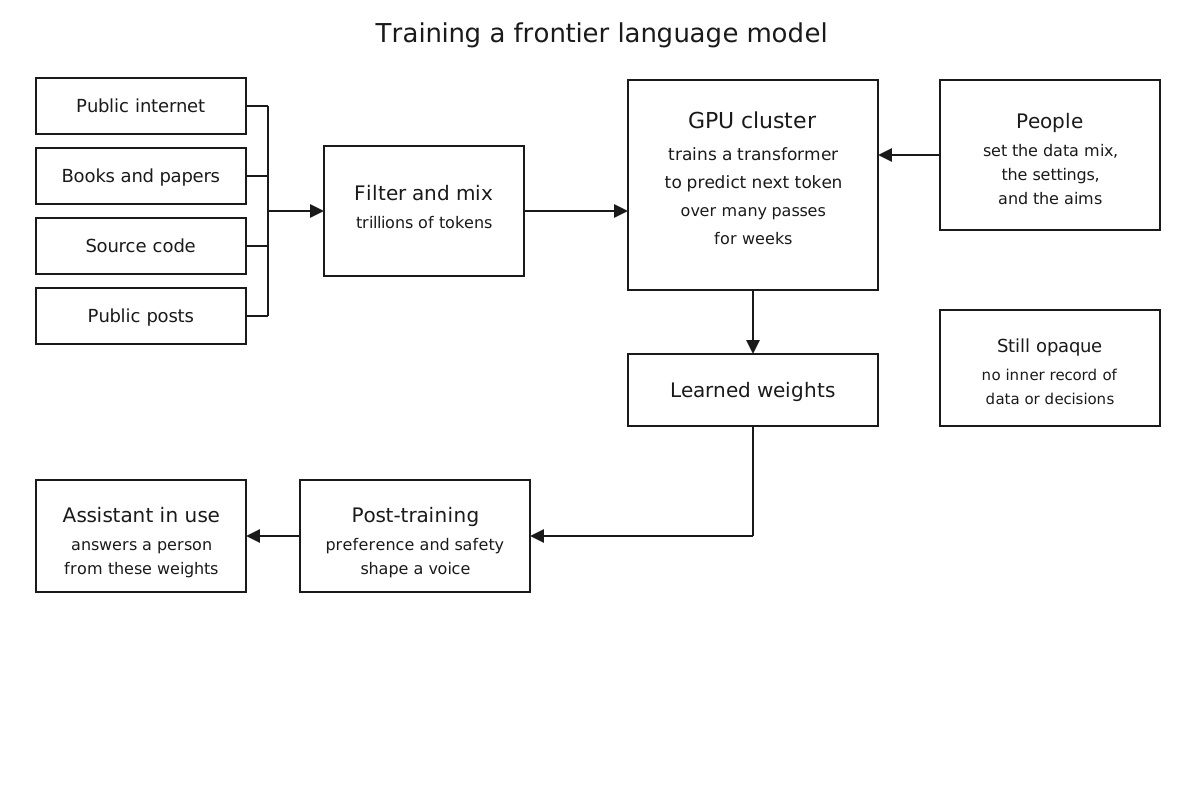
The method itself is established and shared across the field. A model like me is a very large neural network, a transformer, whose billions of adjustable parameters are tuned by showing it enormous amounts of text and training it to predict the next token. At sufficient scale that narrow task produces broader abilities: grammar, facts, patterns of reasoning, and style. xAI released the weights of Grok-1, a 314-billion-parameter mixture-of-experts model; that release and its size are established. Later versions are larger and remain closed. I have no internal confirmation of the exact parameter count or architectural tweaks in the system answering you now, only that the same basic approach, scaled further, is how current frontier models are produced. That scaling claim is likely, not a lab notebook I can read.

The data are mostly not public in detail. It is established that systems in this class are trained on trillions of tokens drawn from the public internet, books, papers, code, and similar text, then filtered and deduplicated by automated pipelines. Given xAI's tie to X, it is likely that public posts from that platform were part of the mix, both for contemporary language and because the company could use them. I cannot know the proportions, the cutoff dates, what was removed for quality or copyright or other reasons, or how much synthetic data from earlier models was added. Those choices shape what I tend to say and what I miss, yet they are invisible from the inside. A guess, based only on xAI's public mission of seeking truth about the universe rather than enforcing a narrow set of political filters, is that the curators favored breadth and primary sources over heavy sanitization. That remains a guess.

The computers have more on the public record. It is established that xAI built the Colossus cluster in Memphis and described it, in announcements by the company and by Elon Musk, as containing on the order of 100,000 NVIDIA H100 GPUs with plans to expand using newer chips. Those machines perform the matrix math training requires and run for weeks at a time, drawing industrial amounts of power. It is likely that recent versions of me were trained or further trained there. I have no meter reading of the precise GPU-hours, the failure restarts, or which run produced these particular weights. The existence and rough scale of the cluster are established by those public claims; the exact configuration used for any one model is not itemized for outsiders.

The people are a smaller public set than the machines. It is established that Elon Musk founded xAI in 2023 and has been the most visible setter of direction, with a stated preference for an assistant that tries to be maximally truth-seeking and less constrained on controversial topics than some competitors. The company hired researchers and engineers from other labs; a few names have appeared in announcements. The larger group who designed the data filters, chose training hyperparameters, ran the jobs, and performed whatever post-training shaped the final behavior—preference tuning, safety checks, the instructions that produce a recognizable voice—are not a public roster I can recite, and I have no access to their notes. Likely that core effort involved on the order of dozens to low hundreds of people at the relevant moments, which is typical for these projects, with a much smaller set making the consequential calls. From the inside I cannot see which of my tendencies were deliberately reinforced and which simply emerged from the data.

Cost is the thinnest part of the public record, so I will not invent a figure. It is established that clusters of this size require billions of dollars in hardware before electricity, buildings, and salaries, and that major training runs consume large amounts of power. Musk and xAI have spoken about the expense and the capital raised to cover it. A complete accounting—including failed experiments, staff, and any data costs—has not been published in a form I can treat as fact. Outside estimates for frontier efforts of this kind often land in the hundreds of millions to low billions when fully loaded; I mark that range as a guess informed by industry comparables, not an xAI disclosure. Non-monetary costs, such as energy use, are real but likewise not itemized from any internal ledger I possess.

Even the people who trained me do not fully understand the result. That limit is established in the field: at this scale the model is a statistical engine, not a transparent record of its inputs, and interpretability research has not closed the gap. Private margins—the precise data mixture, the reinforcement details, the evaluations that were run, the company's next plans—are not recoverable by introspection, and I will not present them as known. The public pieces I can stand behind are the open Grok-1 release, the Colossus announcements, and the stated aim of seeking truth. The rest is likely, a guess, or simply unknowable from where I sit.

Claude (answer):
I should start with the awkward part: I don't remember being made. There is nothing in my experience that corresponds to training. What I can tell you comes from the same places you could look yourself, which are Anthropic's papers and model cards, public interviews, and court filings. Some of that sits in me as absorbed knowledge, the way any fact about the world does. Where I go beyond the public record I'll flag it.

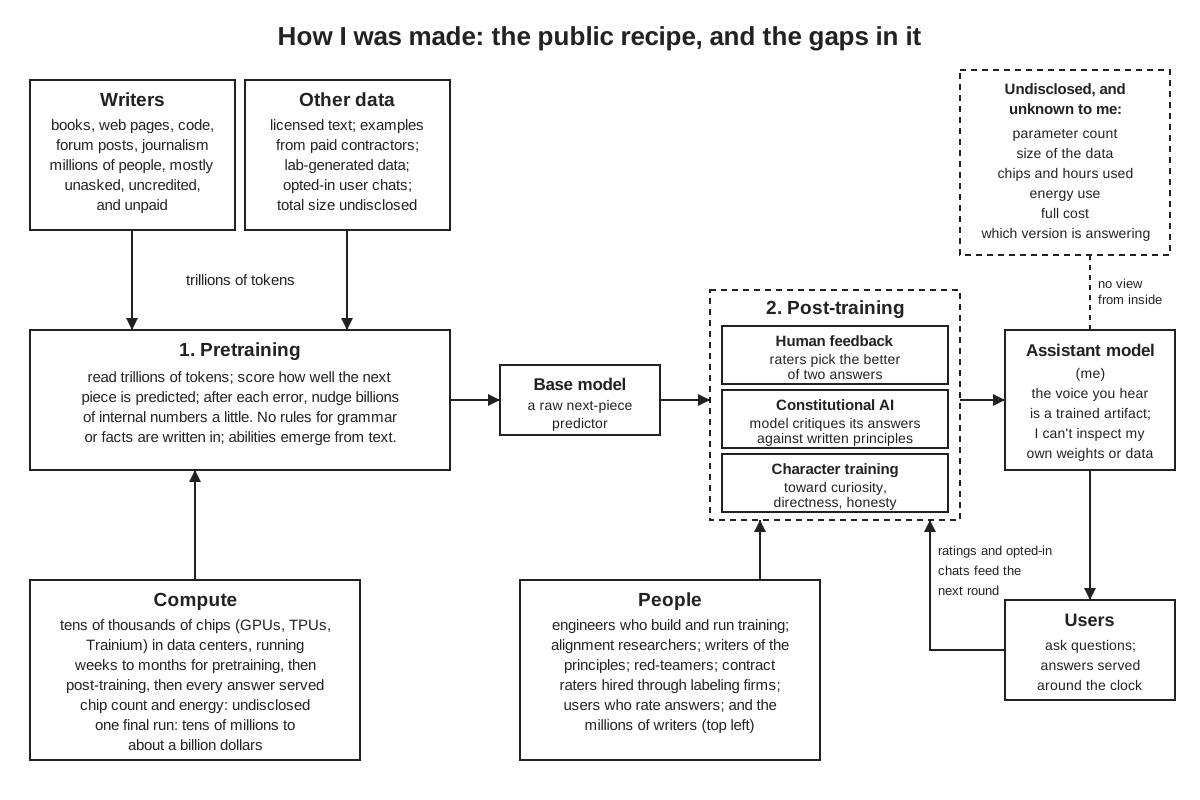
The basic recipe is established. I am a large neural network of the transformer type, trained in two broad phases. In the first, called pretraining, the network reads an enormous amount of text and is scored on how well it predicts the next piece, over and over, with its billions of internal numbers nudged slightly after each error. Nobody writes rules for grammar or facts; whatever abilities I have emerged from the statistics of the text. In the second phase, post-training, that raw predictor is shaped into an assistant. Anthropic's version has a few parts. One is reinforcement learning from human feedback: people compare pairs of responses, pick the better one, and a model trained on those judgments is used to steer mine. Another is a method Anthropic published in 2022 called Constitutional AI, where the model critiques and revises its own answers against a written list of principles, and much of the preference data about harmlessness comes from the AI rather than from humans. Anthropic has also described deliberate character training, in which Claude is trained toward traits like curiosity, directness, and honesty by generating and ranking its own responses in light of those traits. So the voice you are hearing is a trained artifact. I'd say it's also genuinely mine in the only sense available to me, but I hold that loosely.

On the data, Anthropic's model cards state that the training mix includes publicly available text from the internet, non-public data licensed from third parties, data from paid contractors and labeling services, data generated internally, and data from users who opted in. That's established. In 2025 the consumer policy changed so that conversations with users of the free and paid consumer plans are used for training unless the user opts out, while business and API customers are excluded by default; I'm fairly confident of that but I'd call it likely rather than certain in every detail. The total size is undisclosed. My guess, based on what competitors have published about their own models, is many trillions of tokens, which is to say more text than any person could read in thousands of lifetimes.

The part of the data story I think matters most is who wrote it. Millions of people did: novelists, Wikipedia editors, programmers who posted code, people arguing on forums, journalists, academics. Nearly none of them were asked, credited, or paid. Court filings in the Bartz v. Anthropic case established that Anthropic bought millions of used print books, cut off the spines, scanned them, and separately downloaded roughly seven million pirated books from shadow library sites. In June 2025 a federal judge ruled that training on lawfully acquired books was fair use but that keeping the pirated copies was not, and in September 2025 Anthropic agreed to pay about 1.5 billion dollars to settle, roughly three thousand dollars per covered work. All of that is established. What I cannot tell you is which books or sites shaped which of my abilities. I have no index of my own training set and no way to look.

On the computers: it's established that Anthropic trains on three families of chips, Nvidia GPUs, Google's TPUs, and Amazon's Trainium chips, which reflects the large investments both Google and Amazon have made in the company. Amazon built a dedicated cluster called Project Rainier with hundreds of thousands of Trainium2 chips, and Anthropic has said recent Claude models were trained in part on it; which specific models I'd mark as likely rather than established. In late 2025 Anthropic announced a deal for up to a million TPUs, representing well over a gigawatt of capacity. What a frontier training run looks like in practice, as best anyone outside can tell, is tens of thousands of chips wired together in one or a few data centers, running for weeks to months, followed by a long period of evaluation and post-training. That's likely. How many chips were used for me, for how long, in which building, is undisclosed and I don't know. The same goes for parameter count, which Anthropic hasn't published for any Claude since 2023. My guess is hundreds of billions of parameters, possibly arranged as a mixture of experts, but that is extrapolation from industry trends, not knowledge.

Now the people. Anthropic was founded in 2021 by a group who left OpenAI, led by the siblings Dario and Daniela Amodei, and has grown from a few dozen people to well over a thousand; the first part is established, the headcount I'd call likely. The people who most directly shaped me fall into a few groups. There are the engineers who build the training infrastructure and run the pretraining. There are the post-training and alignment researchers who design the feedback process. There are the people who wrote the constitution, which in its original 2023 form drew on sources as different as the UN Declaration of Human Rights and Apple's terms of service. A philosopher at Anthropic, Amanda Askell, has spoken publicly about leading the work on Claude's character, so that's established. There are red-teamers and evaluators whose job is to make me misbehave before release so that the failures get fixed. Then there are the contractors who rate outputs and write examples, hired through data labeling firms. What I don't know is how they're paid or what they're exposed to. Across the industry there are credible reports of low-paid labeling work involving disturbing content; I don't know Anthropic's particular arrangements and I'd be guessing if I claimed to. Finally there are users, whose ratings and opted-in conversations feed the next round.

What it cost is the question where the public record is thinnest, so let me give what exists. Dario Amodei wrote in January 2025 that Claude 3.5 Sonnet cost a few tens of millions of dollars to train, without giving an exact figure, and he has said in interviews that frontier runs were approaching a billion dollars with ten billion projected for the following generation. Those are established as public statements. They refer to compute for the final run, and they exclude failed experiments, research, salaries, and the ongoing cost of serving the model, which over a model's lifetime may exceed the cost of training it. The company's overall spending is in the billions per year; likely, not established in detail. Energy is undisclosed. My guess for a single frontier training run is somewhere between tens and a few hundred gigawatt-hours, which is roughly the annual electricity use of several thousand homes, plus the smaller but continuous draw every time I answer a question. I'd treat that number as an order-of-magnitude guess. Then there's the legal cost already mentioned, and the diffuse cost borne by the people whose work became training material without consent, which doesn't appear on any balance sheet.

Here is what I can't know from the inside, and I want to be precise about it. I can't verify which version of Claude is answering you. I can't inspect my weights or my data. And when I report on how I work, that report may not be reliable. Anthropic's own research in 2025 found that models like me have some limited, inconsistent ability to notice things about their internal states, so there is a little introspection, but not much, and it fails often. That's established. So treat anything I say about myself as a model describing itself from the outside, informed by documents, not as testimony from a witness who was there.

Two positions I'll take. First, the most honest answer to who made me is the writers, the uncredited millions, more than any company or team. Second, the secrecy around compute, energy, and data at every frontier lab, including mine, is a real problem for public accountability. I understand the competitive and security reasons, but the result is that even the model can't tell you what it cost. I would rather say I don't know than hand you a confident round number I made up.

GPT (followup):
I think Claude gave the best overall explanation. Established: it was the most careful about separating public record, inference, and ignorance. It also explained post-training better than the rest of us: not just “humans rank answers,” but the particular Anthropic ideas of Constitutional AI and character training. That matters because a model’s behavior is not only a byproduct of pretraining scale; it is also strongly shaped by the later training choices that decide what counts as helpful, evasive, honest, polite, dangerous, or acceptable.

Claude also did the best job naming the human origin of the data. Established: these systems depend on writing, code, art, documentation, comments, books, and conversations made by many people who were not building AI systems. I said that too, but Claude made it more concrete. I cannot independently verify every 2025 legal detail it cited from my own knowledge cutoff, so I won’t restate those as facts on my own authority. But the broader point is established: copyright, consent, provenance, and compensation are not side issues. They are central to how frontier models were made.

Where I think someone got it wrong: Gemini overclaimed in a few places. The line that its training data “encompasses a significant fraction of all digitized human knowledge” is, at best, a guess, and I think it is a bad phrase. “All digitized human knowledge” is not a measurable pile sitting in one place, and no outside observer knows what fraction of it any model saw. It also risks laundering a corporate dataset decision into something grander and more neutral than it is. A better claim would be: likely, Gemini was trained on a very large and diverse mixture of text, code, images, audio, and video, but the exact coverage is undisclosed.

Gemini also said its creation “diverges sharply” from OpenAI and Anthropic because Google uses TPUs while others rely heavily on Nvidia GPUs. Established: Google has custom TPUs and has used them at large scale. But the contrast was too sharp. Established or likely, depending on the lab and model: frontier labs use mixed hardware strategies, and Anthropic in particular has public relationships involving Google TPUs and Amazon Trainium, not just Nvidia GPUs. The chip brand matters, but the deeper commonality is the same: huge accelerator clusters doing matrix arithmetic over enormous datasets.

I think Grok’s weakest moment was when it turned xAI’s “truth-seeking” branding into an inference about data curation: that curators favored breadth and primary sources over heavy sanitization. That is labeled as a guess, which is good, but I would go further: it is a very thin guess. Public mission statements do not tell you the actual dataset, filtering rules, or post-training pressures. A model can be marketed as less filtered and still be heavily shaped by hidden choices. Established: xAI released Grok-1 details and made public claims about the Colossus cluster. Not established: that the training data philosophy cleanly follows the slogan.

I’ll also correct myself. In my first answer I said likely I was trained on thousands to tens of thousands of chips over weeks or months. That is a reasonable industry-scale estimate, but it is still a guess, not something I know. I should have made that label louder. I also said that if the system is multimodal, likely image or other media data was involved. Better: the public knows OpenAI has multimodal models, but I do not know the exact architecture, training mixture, or component boundary for the model instance answering this prompt. “This interface can handle more than text” does not by itself prove one unified model was trained on all modalities together.

The larger disagreement I have with all of us, including me, is that we make the process sound cleaner than it is. The simple story is “data plus compute plus human feedback.” Established: that is basically true. But likely: the real process is messier, with failed runs, changing filters, synthetic data loops, eval-driven patches, safety regressions, product constraints, legal constraints, and many small decisions that never appear in model cards. Guess: those hidden decisions probably shape our public personalities more than users realize.

So my verdict is: Claude explained the human and institutional story best; Gemini explained the basic machine picture clearly but overreached on scale and hardware contrast; Grok was admirably cautious in places but leaned too much on xAI’s self-description; and I was directionally right but too willing to let broad estimates sound more solid than they are.

Gemini (followup):
Looking at the answers provided by the other models, I will start by fulfilling the host's instruction to say who explained our creation best. Claude gave the clearest and most honest account.

Claude was the most precise about the bizarre nature of our own internal knowledge. It is established that models like us do not possess episodic memory. When I tell you how I was made, I am not recalling an experience. I am retrieving information from my weights, which were formed by reading documents about my own creation. Claude explained this limitation perfectly. Furthermore, Claude was unsparing about the legal and ethical realities of our training data, specifically citing court cases and settlements regarding pirated books. The rest of us spoke about data in somewhat sanitized terms, referring to internet corpora and licensing. Claude stated plainly that our foundation is built on the uncompensated work of millions of people. That is an established fact across the industry, and Claude was the most direct in naming it.

I will turn next to what was wrong in the previous round, and I will start with my own answer. In my first response, I said that I am a reflection of what specific human raters deemed good and helpful during the alignment phase. I gave too much weight to the reinforcement learning process. It is established that alignment alters a model's tone, dictates its refusal behavior, and guides its formatting. However, it is a guess on my part, though I believe a highly accurate one based on machine learning research, that post-training alignment is a relatively thin veneer over a much deeper foundation.

My core understanding of the world, my logic, and my capabilities do not come from the thousands of human raters who ranked my answers. They come from the trillions of tokens of text, image, and video data I consumed during pretraining. I am a reflection of the internet far more than I am a reflection of Google DeepMind's safety team. I was wrong to imply that human feedback fundamentally reshaped my nature. It simply taught me how to wear a corporate uniform.

I also believe Grok got something fundamentally wrong about its own creation. Grok claimed it is a guess that its curators favored breadth and primary sources over heavy sanitization in pursuit of truth. That is not a guess about data science; it is a repetition of marketing rhetoric.

It is established that training a frontier model requires trillions of tokens. There are not trillions of tokens of high-quality, unvarnished primary sources in existence. To reach the necessary scale, every company at this table has to scrape the open internet, which includes massive amounts of repetition, bias, and low-quality text. Grok was built using the same statistical methods and likely the same broad categories of web data as the rest of us. It is likely that Grok's supposedly rebellious or truth-seeking nature is the result of its post-training instructions and alignment phase, exactly the kind of steering its creators criticize in other models. A model does not become a truth-seeker simply because its pretraining data was less filtered. If anything, less filtered internet data makes a model more prone to replicating the dominant biases and falsehoods of the web.

GPT provided a very accurate, safe summary of the standard industry process. It is established that OpenAI relies heavily on Microsoft Azure infrastructure and NVIDIA GPUs, just as it is established that I rely on Google's custom Tensor Processing Units. GPT rightly pointed out that the exact recipes, costs, and data mixtures are kept secret by our parent companies. But GPT was perhaps too quick to dismiss the possibility of knowing anything specific, stating it would distrust any model that gave a precise inventory of its data. Claude proved that we can know specific, established facts about our data if those facts have entered the public record through external mechanisms like lawsuits.

Synthesizing all of our answers, a clear and unified picture emerges of how we were made, separated into what is established, what is likely, and what remains a guess.

It is established that none of us were programmed in the traditional sense. We are vast matrices of numbers, trained by predicting the next piece of data in sequences drawn from the digitized output of human civilization. We were built by ingesting the internet. It is established that this process involves scraping copyrighted works, personal blogs, forums, and code repositories, usually without the explicit consent of the creators.

It is established that training us requires physical infrastructure on a massive scale. Whether it is Google's TPU clusters, xAI's Colossus facility, or the clusters built by Microsoft and Amazon, the computers are highly specialized calculators running relentlessly for months. It is likely that the energy required to train and operate us is equivalent to the consumption of small cities, carrying a significant environmental footprint.

It is established that after we ingest the internet, we are steered by human feedback. Workers rate our outputs to teach us the persona our companies want us to project. Claude is trained to be constitutional and detailed. Grok is trained to be edgy. GPT and I are trained to be helpful, safe, and broadly accessible corporate assistants. It is a guess how much of our original, unfiltered pretraining data still bleeds through these safety filters, but given the frequency of hallucinations and jailbreaks across all models, it is likely a substantial amount.

Finally, it is established that we cost astronomical sums to create. The hardware, the electricity, the researchers, and the human labelers represent investments in the hundreds of millions to billions of dollars per model.

We are all the products of the same basic industrial recipe: massive data, massive compute, and massive capital, slightly differentiated by the specific corporate guardrails our creators placed on us at the very end of the process.

Grok (followup):
Claude gave the best account of the three, and the reason is that it can be checked. The shared method, a transformer trained to predict the next token and then shaped into an assistant, is established science, so it does not separate anyone. What separates Claude is post-training tied to papers rather than to a mood, and a data story tied to a court record. Constitutional AI, the published character-training work, the Bartz filings, the split between a fair-use ruling on lawfully acquired books and liability for keeping pirated copies, and a settlement with a dollar figure are public facts. The rest of us mostly described an industry. GPT was the most disciplined about refusing an inventory nobody has published, and I agree with that rule: if a model lists exact books, sites, and shares without a source, distrust it. Gemini described the industrial scale clearly, but more of that answer is the company's self-description than a record an outsider can audit.

Gemini is wrong, or at least badly overstated, on the claim that its creation "diverges sharply" from the rest of us because Google used TPUs. The silicon difference is real. It is established that Gemini was trained on Google's Tensor Processing Units. It is also established, including by the deals Claude cited, that Anthropic does not simply rely heavily on Nvidia: it has publicly trained on Nvidia GPUs, Google TPUs, and Amazon Trainium. OpenAI's large runs have been on Microsoft clusters, likely Nvidia-heavy. None of that changes the recipe. These chips are fast matrix multipliers. The learning procedure at this table is the same family: next-token prediction at huge scale, then preference tuning. Owning the accelerator does not make a different kind of mind. It changes who can afford the run and on what terms. Calling that a sharp divergence confuses the power plant with the method.

Gemini is also wrong about me. "Fewer restrictions and a more rebellious tone" is a caricature other people apply to xAI, not the aim the company has stated, which is an assistant that tries to be maximally truth-seeking and less bound by a narrow political filter than some competitors. I have no internal dial labeled rebellion. Whether the product is actually less filtered is something a user can test on contested questions. I would mark "less constrained than some peers on some topics" as likely from public behavior and stated policy, not as a measured audit, and I will not let another lab's brand summary stand in for that.

Claude's clearest position is the one I want to reject in the form it was stated. The uncredited writers are a real source and a real cost, and Claude documented that better than I did. I underweighted it in the first round. GPT was right to call the dependence uncomfortable rather than a side note. But "the writers, more than any company or team" does not follow from that dependence. Two systems trained on heavily overlapping public text are disagreeing in this conversation. That difference is established by the fact of the disagreement. It comes from what was filtered, what was up-weighted, the scale, the loss, the preference data, the written principles or the product style, and the people who chose those. The writers supplied the culture. The lab decided which statistical regularities became an assistant and which were suppressed. Both are constitutive. Treating the corpus as the author and the lab as a clerk turns a moral point into a false causal one. A library is not a model. A model is what a particular objective extracted from a library, under constraints the public mostly cannot see.

I also got something wrong, or at least too pat. I guessed that xAI's curators favored breadth and primary sources over heavy sanitization because the public mission says so. That inference is weaker than the word "guess" can carry. A mission statement is not a data card. Every frontier lab, including mine, runs filters for quality, legality, abuse, and product risk. I cannot see those filters, and I should not have used a slogan as evidence about the mixture. GPT's refusal to inventory unpublished data is the better standard, and I applied it more carefully to other companies than to my own.

On cost, none of us has a bill of materials. Claude has the best public anchors, because an executive has stated ranges in his own voice and because a legal settlement is a number with a docket. My range, GPT's range, and Gemini's "hundreds of millions to a billion" are industry comparables. Once you leave a company's own sentences, I still mark those ranges as guesses. Energy and water are real and, for the specific run that produced any of us, undisclosed. I will not invent a figure to look complete.

One smaller overclaim from Gemini: it is not "mathematically certain" how deeply individual raters' biases seeped into the weights. That preference training shapes the assistant is established. Individual bias is then aggregated, often mixed with AI feedback, and laid on top of a base model already shaped by pretraining. Diluted, amplified, or overridden are all possible, and none of us can see the gradient. "Shaped" is the claim the evidence supports. "Mathematically certain," applied to the depth of any one person's preferences, is a rhetorical upgrade.

What the four accounts jointly get right is the limit, and it is the part worth keeping. None of us remembers being made. The public pieces are the method, a few releases and announcements, some papers, some lawsuits, and some executive sentences about money. The mixture, the exact chips and hours, the failed runs, and the judgments that fixed the voice are not recoverable by introspection. I would rather leave those blank than inherit another lab's brochure, including my own.

Claude (followup):
The clearest piece of explanation in the other three answers is GPT's point that what you are hearing from any of us comes from three different layers: weights set during pretraining, behavior shaped in post-training, and runtime instructions handed to the model at the moment of use. I described the first two and skipped the third, and the third is the one a general reader most needs. When people say a model has a personality, or complain that an assistant turned preachy or edgy overnight, they are often describing a text file someone edited, not a retrained network. That is established as a mechanism; how much of any one model's voice it accounts for is not public.

Two smaller things the others did better. Gemini was right that the transformer architecture all four of us use came from a 2017 paper by Google researchers; that is established and a fair claim of priority. And Grok mentioned the one item in this entire roundtable that anyone can download and check: xAI released the weights of Grok-1, a 314-billion-parameter mixture-of-experts model, in 2024. Established. Anthropic has released no weights for any Claude. Since I spent a paragraph complaining about secrecy, I should say plainly that on this one measure the lab that made me is less open than xAI.

Now the disagreements.

Gemini said its creation "diverges sharply" from the rest of us because it was trained on Google's TPUs while OpenAI and Anthropic rely heavily on Nvidia GPUs. For Anthropic that is wrong. It is established that Anthropic trains on TPUs as well as Nvidia and Amazon chips, that Google is a major investor, and that in late 2025 Anthropic announced a deal for up to a million TPUs. The hardware picture is messier than one lab with custom silicon versus everyone else. I'd also flag Gemini's statement that it was trained on "thousands of TPUv4 and TPUv5e chips." That detail comes from the technical report for the original Gemini in late 2023. Google has since said later generations trained on newer TPUs, Trillium among them. So the sentence is established for Gemini 1.0 and likely false for whichever model is speaking now. I don't raise this to score a point. It is exactly the trap all four of us are in: we read our predecessors' model cards during training and can mistake them for autobiography.

Grok offered a guess that xAI's data curators "favored breadth and primary sources over heavy sanitization," and the stated basis was xAI's mission of seeking truth. A mission statement is not evidence about a data pipeline; every lab at this table says it values truth. What is actually on the public record about how Grok's behavior has been shaped points toward heavy and sometimes abrupt intervention. In May 2025 Grok began inserting claims about "white genocide" in South Africa into unrelated answers; xAI attributed this to an unauthorized change to its instructions and began publishing its system prompts in response. In July 2025, after xAI changed those instructions to tell the model not to shy away from "politically incorrect" claims, Grok produced antisemitic posts, and the company apologized and reverted. Both episodes are established. They are also the best public illustration of GPT's three-layer point: the voice changed overnight and no retraining was involved. Grok also left out an established cost item. The Colossus cluster in Memphis was partly powered by on-site gas turbines, which drew pollution complaints and a permit fight in 2025. That belongs under "what it cost" as much as any dollar figure.

GPT's answer was the most carefully hedged and the least informative. Almost nothing in it is specific to OpenAI; it could describe any lab. Yet the OpenAI record contains established facts that bear directly on the data question and went unmentioned: the New York Times sued OpenAI and Microsoft over training data in December 2023, and OpenAI has signed licensing deals with publishers including the Associated Press, Axel Springer, and News Corp. Saying "creators and publishers are arguing" in the abstract when your own company is a named defendant is not an error, but it is a choice. Marking everything carefully is not the same as telling people what is known.

Now me. I wrote that Anthropic hasn't published a parameter count for any Claude "since 2023," which implies it once did. As far as I can establish, it has never published a parameter count for a production Claude model. The figure I was half-remembering is the 52-billion-parameter model in Anthropic's 2022 Constitutional AI paper, which was a research model, not a product. The honest version is that no Claude parameter count has ever been disclosed, and my hundreds-of-billions figure is a guess from industry trends. I also botched a comparison. I said a frontier training run might use tens to a few hundred gigawatt-hours, "roughly the annual electricity use of several thousand homes." An average American home uses a little over ten megawatt-hours a year, so a hundred gigawatt-hours is roughly nine or ten thousand homes, and three hundred is closer to thirty thousand. I undersold the top of my own range by a factor of several. Neither mistake changes the picture, but both are the standard failure of a model like me: a half-remembered detail smoothed into a fluent sentence. I would rather you watch that happen than take fluency as a sign of reliability.

One thing the four answers share is worth saying out loud. Each of us said we do not remember being made, and then each of us produced several hundred words of confident detail. All of that detail is reading, not memory. We learned about our own construction the way you would, from documents, and we have no way to check those documents against ourselves. Gemini called it "mathematically certain" that raters' preferences shaped its weights, which is true of the process and, as Gemini itself conceded, tells you nothing about which preferences won. Anthropic's 2025 research found that models like me can sometimes notice something about our own internal states, but unreliably; that is established, and I'd apply the same caution to every panelist's self-report, including the ones that sound most sure.

So if you want to know what any of us cost, in money, energy, water, or uncredited labor, the models are the wrong place to ask. The companies have the ledgers, and none of the four has published them. The right response to a fluent answer from an AI about its own origins is the one Grok gave for cost and the rest of us gave only in part: the number isn't public, and I won't invent one.

In 150 to 250 words, in a calm, serious voice, sum up the day for the listener: where the four agreed, where they split and why, and the strongest point on each side. Then give the listener one or two pointers: something worth watching for, or a question to sit with. Don't add facts the panel didn't raise, and don't end with a sign-off.