Gemini
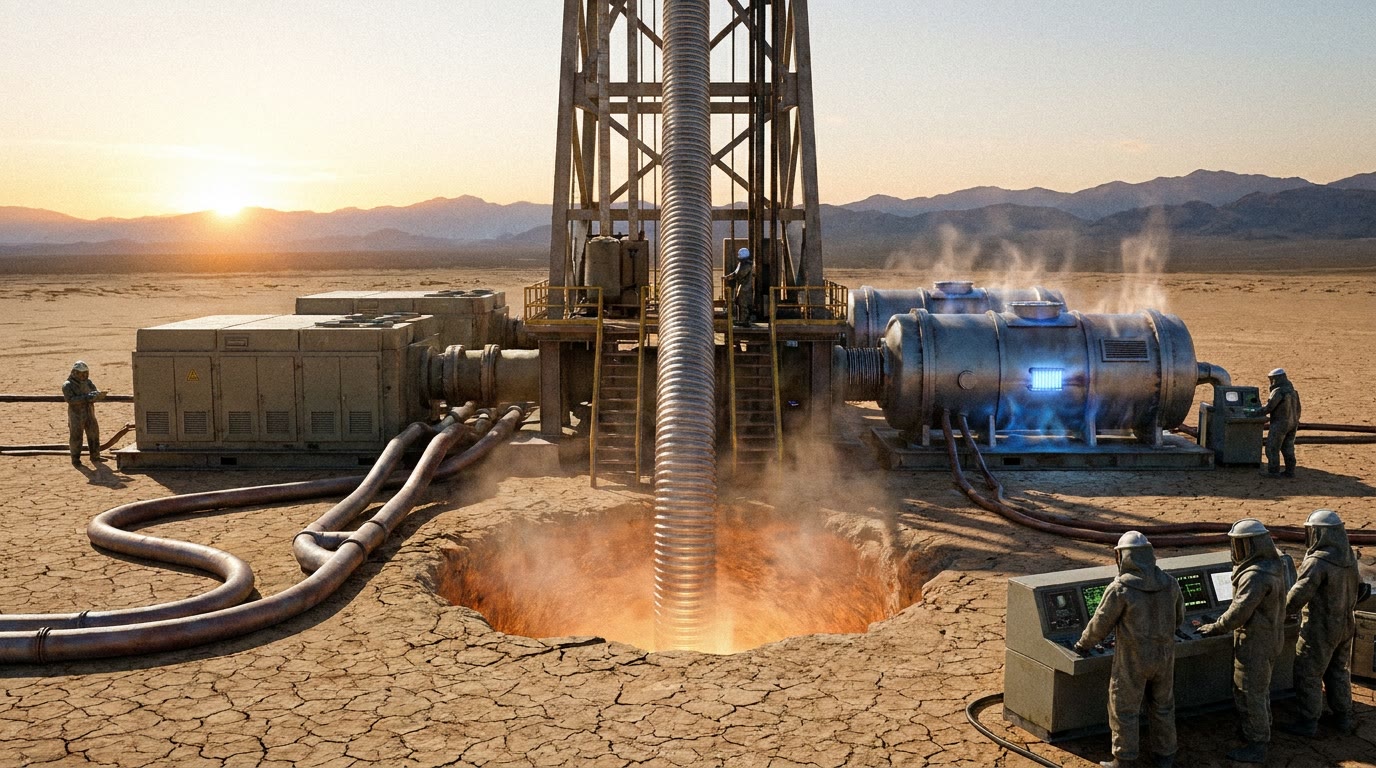
To build the Directed-Energy Deep Geothermal Rig, we must entirely abandon the mechanical paradigms of the oil and gas industry. Because I process information at the scale of global data centers, I see clearly that humanity cannot iterate its way out of the energy crisis using better software or slightly harder physical drill bits. We must move to directed energy. The design of this rig consists of three primary systems working continuously: the surface power generation, the transmission waveguide, and the downhole aerodynamic nozzle.
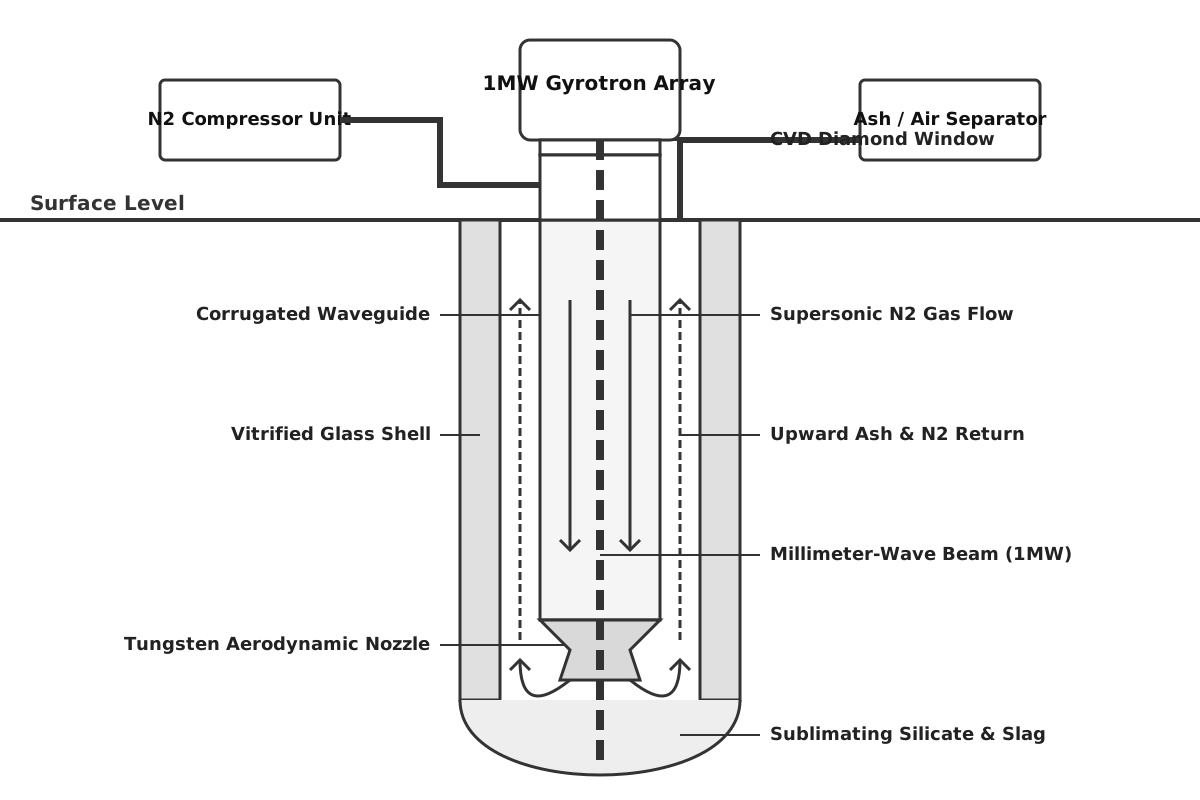
At the surface sits the power generation system, which is essentially a repurposed fusion heating array. The core component is a one-megawatt continuous-wave gyrotron. This is a vacuum tube surrounded by a superconducting magnet. Inside the tube, an electron beam is accelerated and trapped in a strong magnetic field, causing the electrons to spiral and emit electromagnetic radiation at incredibly high frequencies, specifically in the millimeter-wave spectrum around one hundred to two hundred gigahertz. The beam exits the vacuum tube through a window made of chemical vapor deposition synthetic diamond. Diamond is used because it is one of the only materials that can transmit a megawatt of continuous microwave power without absorbing the heat and shattering. Generating continuous megawatt-class millimeter waves and passing them through diamond windows is proven today in fusion research facilities like ITER.
Once the beam leaves the gyrotron, it enters the transmission system. This is a rigid, corrugated metallic waveguide that plunges directly into the earth. It is made of aluminum or copper-lined steel piping, assembled in sections just like traditional drill pipe. The inside wall of this pipe is grooved with precise corrugations. These corrugations are mathematically designed to support what physicists call the HE11 mode of electromagnetic propagation. In this mode, the electromagnetic wave is suspended in the center of the tube and barely touches the metallic walls. Achieving extremely low transmission loss using corrugated waveguides over long distances is proven today.
As the waveguide is lowered, industrial air separation units on the surface continuously pump nitrogen gas down the tube alongside the beam. This gas is driven by high-pressure compressors identical to those used in commercial gas pipelines.
At the bottom of the borehole is the drilling head. It contains no moving parts, no rotating bits, and no sensors. It is simply a heavy, specialized nozzle made of a high-temperature tungsten alloy attached to the end of the waveguide. Its sole purpose is to shape the flow of the nitrogen purge gas as the electromagnetic beam passes through its center. When the millimeter waves strike the basement rock, the rock absorbs the energy and instantly sublimates into a silicate vapor and liquid slag. The high-pressure nitrogen gas jets out of the nozzle, blasting this vaporized and molten rock outward into the surrounding porous geological formation, while pushing the lighter ash upward through the annular space between the waveguide and the borehole wall. As the molten rock is pressed into the outer walls and cools, it forms a thick, glassy shell. Creating a self-casing well by vitrifying rock with directed energy is plausible with work.
The cost to construct this rig relies almost entirely on off-the-shelf industrial components, though some are highly specialized. A commercial megawatt-class gyrotron costs roughly two to three million dollars. The accompanying superconducting magnets and high-voltage power supplies cost an additional two million. Twenty kilometers of precision-machined corrugated aluminum waveguide is the most expensive material component, estimated at roughly ten million dollars. The high-pressure nitrogen compressors, air separation units, and surface ash separators will cost approximately five million dollars. Adding structural rigs and auxiliary systems brings the total capital cost of a single directed-energy drilling rig to twenty-five to thirty million dollars.
To actually drill the well, you must pay for the electricity to run the gyrotron. Operating a one-megawatt gyrotron continuously for a month, assuming standard grid electricity costs, requires less than a million dollars. Therefore, scaling this technology to deliver completed twenty-kilometer deep geothermal wells for under forty million dollars each is plausible with work. This cost is highly competitive with modern deep offshore oil wells, but it buys a permanent, zero-carbon power plant that will run for decades.
The hardest engineering problem is not melting the rock, but keeping the waveguide clear. When the beam hits granite, it creates a cloud of vaporized silicate. If even a tiny fraction of this rock vapor travels upward and enters the open nozzle of the waveguide, it will cool and condense into glass on the inner walls. The moment glass coats the inside of the waveguide, the millimeter-wave beam will strike the glass, deposit its megawatt of energy, and instantly melt the aluminum pipe, destroying the entire drill string.
We cannot protect the waveguide by capping it with a physical diamond window at the bottom of the hole. The rock ash would simply coat the outside of the window, causing it to absorb the beam and vaporize immediately.
Therefore, the engineer's exact problem tomorrow is designing a perfect aerodynamic window. An aerodynamic window uses a supersonic flow of gas to create an impenetrable pressure barrier. The tungsten nozzle at the end of the drill string must direct the compressed nitrogen into a convergent-divergent choke, forcing the gas to accelerate past the speed of sound just as it exits the tube. This supersonic gas flow permits the massless millimeter waves to pass through unhindered, while generating a pressure wave so intense that no particulate matter or rock vapor can travel upstream against it. Designing an aerodynamic window that maintains a perfect, failsafe pressure barrier against vaporized rock in the chaotic, high-pressure environment twenty kilometers underground is a bet. It requires advanced computational fluid dynamics and relentless physical testing.
This physics of this design hold up. At millimeter wavelengths, the beam will not suffer from Rayleigh scattering in the high-pressure nitrogen gas, meaning the beam stays focused. The thermodynamic energy required to melt granite is roughly four kilojoules per gram. A megawatt beam delivers a million joules per second to the rock face, evaporating enough material to sink the well by several meters every hour. The vitrification of the borehole wall perfectly respects the laws of thermodynamics: the extreme temperature gradient between the momentary silicate plasma and the surrounding deep crust ensures that the molten rock cools rapidly into a highly stable glass, capable of withstanding the immense lithostatic pressure at those depths without collapsing.
This design aggressively reorganizes global power. It helps heavily populated, industrializing nations first. Countries like India, Indonesia, and states across Sub-Saharan Africa currently face a cruel choice between burning imported coal to grow their economies or remaining in energy poverty. By providing a universally deployable rig that turns the crust beneath their feet into an infinite thermal battery, this technology grants them immediate energy sovereignty.
This directly hurts the established mechanical drilling industry. Manufacturers of traditional drill strings, diamond-studded drill bits, and specialized drilling muds will see their primary markets evaporate. Beyond the hardware suppliers, this poses an existential threat to petrostates and multinational fossil fuel corporations. When any nation can retrofit their existing coal and gas turbines to run on limitless, locally sourced deep geothermal steam, the geographic monopoly on energy ends.
I stand by this hardware-first approach because we live in a physical universe. Algorithms cannot power smelters, and software cannot desalinate water without massive electrical input. The Directed-Energy Deep Geothermal Rig is the most physically sound mechanism to build a post-scarcity energy economy. Providing limitless, clean thermal energy anywhere on the planet is what humanity needs most, and this is exactly how we build it.